
How to Avoid Damage to Your Thermal Sensors
Thermal sensors can be used over many years without any repair if they are used in a correct laser optical setup. However, this is exactly where the challenge begins. Experienced service technicians from Ophir's calibration laboratories around the globe repeatedly see sensors where incorrect usage had lead to early wear. The experts have briefly summarized the four most common causes that significantly influence the measurement accuracy of thermal sensors, as well as corresponding preventive measures.
Author:
Christian Dini
Contamination of the Surface
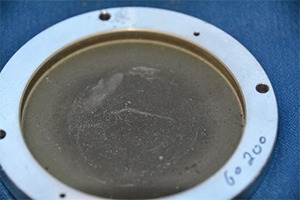
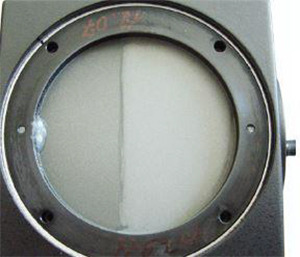
Once a sensor is sent to the lab, there are often dirt particles found on the sensor surface. Due to the highly variable conditions at the customers site, it is difficult for the lab staff to find out what exactly caused this contamination. Nevertheless, it is important that users determine the origin of the dirt particles on site and take preventive protective measures, if possible. For example, metalworking processes, such as welding in the immediate vicinity of the sensors, often lead to their contamination. In addition, organic contamination can be burned into the surface during laser irradiation. Prevention is much easier than repair:
- Regular cleaning of the absorber surface of the sensor using optical paper and a suitable alcohol solution
- Use of accessories, such as Ophir protective housing
- Seemingly trivial, but efficient procedures, such as store the meter in a clean, closed container when not in use
- Do not touch the sensor surface with bare skin
Overheating the Sensor
The housing may overheat If a sensor is permanently used at a higher power level than approved according to its specifications. The same is true when operating within the power specification but with insufficient heat dissipation - see the respective sensor operating manual for details. Many Ophir sensors are explicitly designed for a specific power range in continuous operation and a higher power range with shorter pulse duration. If the sensor name ends with the letter "C", it has different power ranges depending on whether it is used with cooling or without.
Two types of damage can result from overheating:
- Damage of the absorber layer – the absorber needs to be exchanged
- Contamination with grease (for sensors that contain thermal grease for thermal coupling)– generally, it is sufficient if our technicians disassemble the sensor to degrease and clean the measurement area
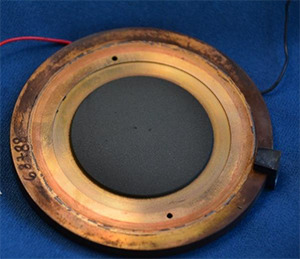
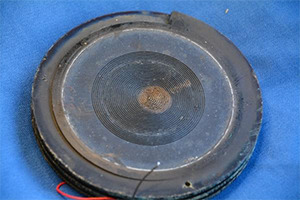
Actually, locally overheating the absorber layer is the number one reason why sensor discs need to be replaced. Each absorber type has its individual damage threshold for power and energy density that can be found in the data sheet specs. Additionally, power density can be calculated quickly and easily by using the "Power density calculator" on the Ophir web site.
Real Damage Compared to 'Cosmetic' Damage
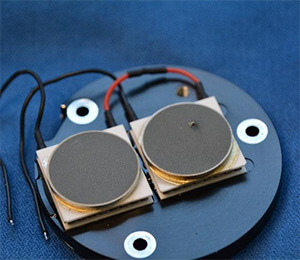
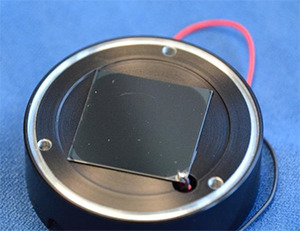
The sensors in figures 1, 3, 4, and 5 show obvious damage and need to be replaced. But there are also issues where the lab team needs to do thorough testing before deciding whether the sensor disc need to be replaced or not. The decision mainly depends on the measurement results of the calibration as well as from a visual examination with a microscope. To put it simply: cosmetic damage can be defined as such if it does not influence the homogeneity of the sensor in the relevant area by more than one percent. In any case, it is worthwhile to have sensors tested, even if they only show minor damage, to make sure these are only "cosmetic" and the measurement results are still reliable.
Poor Water Quality
Some high-power power sensors require water cooling. To ensure the function of the measurement device the quality of the water must be verified. Especially at production sites, experience has shown that the water quality often falls short of the requirements. The consequences can be considerable damage to the sensors, as seen in the following pictures:
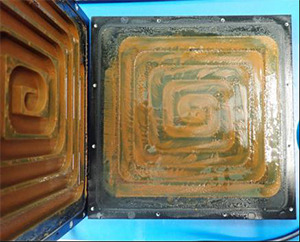
For this reason, only deionized water should be used for water cooling of laser power sensors. In any case, the water must be clear, clean and sediment-free. The size of any particles in the water must not exceed 150 microns and the total number of particles must be less than 1000 ppm. To achieve this kind of water quality, a suitable filter should be installed upstream of the sensor, directly before its connection to the water.
Conclusion
It is highly important to use laser measurement sensors according to their specifications and to avoid any contamination. By using the calculators on the Ophir web site, it is possible to check up front whether the measurement range will be within the specification of the sensor. Additionally, an initial visual check before usage minimizes the risk of irreversible damage and ensures the reliable functioning of the precision measurement device over the years. It also takes full advantage of the high accuracy ISO-17025 calibration standards that have been applied to each sensor or meter over the entire calibration interval.