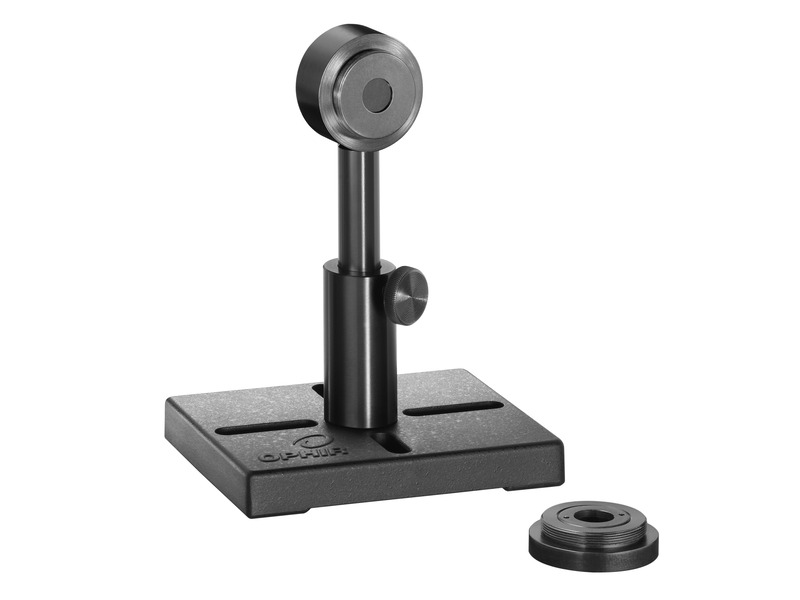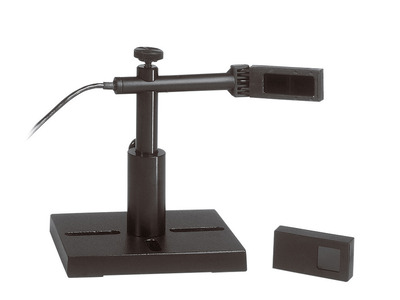
300 mW Silizium Photodioden-Sensor mit Ø10 mm Apertur
300 mW Silizium Photodioden-Sensor mit Ø10 mm Apertur
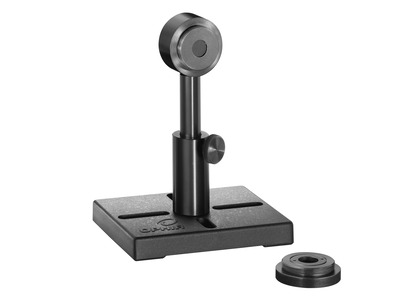
Der PD300R Silizium Photodioden-Sensor ist ein universell einsetzbarer, runder Sensor mit einem austauschbaren Filter und einer 10mm Apertur. Ohne den Filter beträgt der Spektralbereich 350 bis 1100nm und der Leistungsmessbereich 500pW bis 30mW. Mit dem Filter liegt der Spektralbereich zwischen 430 und 1100 nm bei einem Leistungsbereich von 2μW bis 300mW.
- 350-1100 nm Silizium Photodioden-Sensor mit Ø10 mm Apertur
- 500 pW bis 300 mW Leistungsmessbereich
- Wird mit abnehmbaren Filter geliefert
- Glasfaser-Adapter verfügbar Alle Funktionen anzeigen

Spezifikationen
- Aperture SizeØ10 mm
- MaterialSilicon
- Spectral RangeFilter in: 430-1100 nm
Filter out: 350-1100 nm - Power RangeFilter in: 2 µW - 300 mW
Filter out: 500 pW - 30 mW - Maximum Average Power DensityFilter in: 50 W/cm²
Filter out: 10 W/cm² - Maximum Pulse EnergyFilter in: 30 µJ
Filter out: 3 µJ
- Response Time0.2 s
- Cable Length1.5 m
- DimensionsØ35 x 24 mm
- CE ComplianceYes
- UKCA ComplianceYes
- China RoHS ComplianceYes
Funktionen
Measuring Very Low Laser Powers with a Photodiode Sensor
In this short “Basics” video, we review in general the use of photodiode sensors for measuring very low laser powers.
Effects of Incidence Angle on Measurements
In this video, you will learn to what degree a beam’s incidence angle matters, and for which sensor types this should be taken into account.
Häufig gestellte Fragen
- What does the PD300 "Background Subtraction" do?Antwort
Ophir's Photodiode PD300 and PD300-1W sensors offer automatic background subtraction so the measurement is not sensitive to room light. With "filter out" (i.e. the external filter removed for low light measurements), 2 separate detector elements are visible. The beam to be measured is incident only on the outer of the 2 detectors, but background light reaches both detectors. The instrument will show the power measured by the outer detector minus that measured by the inner detector.This patented method cancels out 95% - 98% of background light under normal room conditions, even if it is constantly changing.
- Do I need to recalibrate my instrument? How often must it be recalibrated?Antwort
Unless otherwise indicated, Ophir sensors and meters should be recalibrated within 18 months after initial purchase, and then once a year after that.
Zubehör
Customers that purchase the above items also consider the following items. Ophir-Spiricon meters and sensors include a standard manufacturers warranty for one year. Add a one year Extended Warranty to your meter or sensor, which includes one recalibration.
| Compare | Description | Drawings, CAD & Specs | Avail. | Price | ||
|---|---|---|---|---|---|---|
 | 7Z08229FC Fiber Connector Adapter, Power and Energy Sensors | 2 Weeks | ||||
 | 7Z08226ST Fiber Connector Adapter, Power and Energy Sensors | Auf Lager | ||||
 | 7Z08227SC Fiber Connector Adapter, Power and Energy Sensors | Auf Lager | ||||
 | 1G01236ASMA Fiber Connector Adapter, Power and Energy Sensors | Auf Lager | ||||
 | 1G02259PD300R and FPS-1 Fiber Adapter BracketMounting Bracket, Fiber Adapter | |||||
 | 1G02260Female SM1 to SM1 Adapter | Auf Lager | ||||
 | 7E01125A5 m PD300 Sensor CableOptical Sensor Cable, 5 m Length | |||||
| 7E01125B10 m PD300 Sensor CableOptical Sensor Cable, 10 m Length | |||||
 | XWAR-SENSORErweiterte Garantie für Sensoren |
Ressourcen
Data Sheets
Round Photodiode Sensors 20pW to 3W Datasheet(383 kB, PDF)
Catalogs
Power Sensors Catalog(11.2 MB, PDF) Laser Power & Energy Measurement and Laser Beam Analysis Catalog(27.5 MB, PDF)
Drawings & CAD
PD300R Drawing(184.7 kB, PDF)
Videos
Technical Notes
5 Situations Where Laser Performance Measurement is Necessary Effect of Ambient Conditions on Laser Measurements How do I know what range, or scale, to set my power/energy meter to? Measuring Average Power of Pulsed Lasers with Photodiodes(114.5 kB, PDF) How to Properly Select a Laser Power or Energy Sensor