Every calibration service for your Ophir device includes two important items: a calibration certificate report and a calibration sticker. Both provide key calibration details, including the date the calibration process was completed and the customer‑recommended calibration interval.
Understanding these dates can help you maintain confidence in your measurements and better identify when it may be time to recalibrate your device.
How to Read Your Calibration Dates
To better understand your calibration documentation, it is helpful to know the difference between the dates shown on the report and sticker:
Calibration Date
Found on the report, this indicates when Ophir began the calibration process for the device.
Issue Date
Shown on both the report and the calibration sticker, this is the date the calibration process was completed. For a more detailed explanation, you can read our guide to Understanding Your Laser Measurement Equipment Certificate of Calibration
or watch our video, Introducing: Certificate of Calibration (C.O.C.).
Recommended Calibration Schedules
The recommended calibration date is an important guideline, but the ideal time to recalibrate your device can vary depending on product type, usage conditions, and measurement stability.
In general, recommended calibration timing may differ between new and recalibrated devices, and some products may follow different service intervals. For that reason, it is best to refer to the date listed in your calibration documentation and follow Ophir’s product-specific guidance when available.
Proactive recalibration helps support measurement accuracy, reliability, and long-term performance.
Does the Recommended Date Mean You Must Calibrate on That Exact Day?
Not necessarily.
The recommended calibration date should be viewed as a guideline rather than a strict cutoff point. It does not mean your instrument will suddenly become inaccurate on that date, and it does not guarantee that recalibration will be required immediately afterward.
However, staying close to the recommended service interval is a good practice and can help reduce measurement uncertainty over time.
When to Calibrate Early
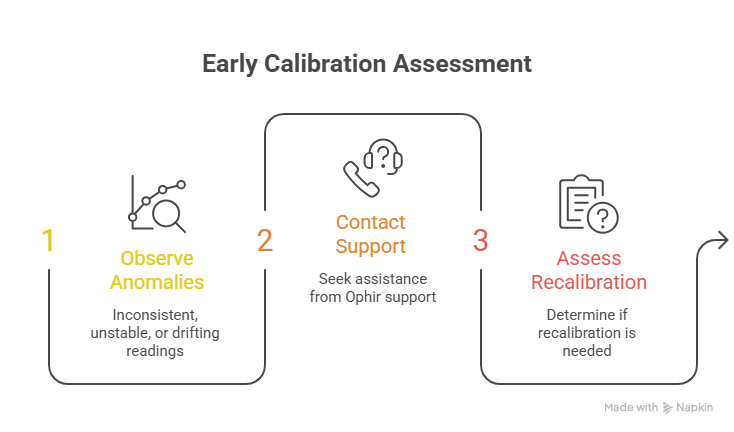
If you notice anything unusual before the recommended calibration date, it may be worth contacting Ophir support sooner.
Examples include:
• Inconsistent or unstable readings
• Measurement results that differ from normal performance
• Unexpected drift
• Unusual behavior after heavy use or demanding operating conditions
In these cases, Ophir support can assist you in assessing whether recalibration may be appropriate.
Why Recalibration Matters
Regular recalibration is an important part of good measurement practice. Over time, factors such as usage, handling, and environment can affect measurement confidence. Recalibration helps ensure that your instrument continues to deliver the precision and accuracy your application requires.
Need Help Understanding Your Certificate or Recalibrating Your Device?
Ophir takes pride in the precision and accuracy of its instruments. If your device is approaching its recommended service date, or if you are seeing unusual measurement behavior, our team will be glad to assist. Ready to recalibrate? Request an RMA or contact Ophir support to get started
Calibration FAQ
How often should I calibrate my Ophir device?
Calibration timing depends on the product type, whether the device is new or previously recalibrated, and how the device is used. The best reference is the date shown on your calibration documentation, along with any product-specific guidance from Ophir.
What is the difference between the calibration date and the issue date?
The calibration date is when the calibration process began. The issue date is when the calibration process was completed and the documentation was issued.
Does the recommended calibration date mean the device becomes inaccurate after that date?
No. It is a guideline, not an exact expiration point. However, following the recommended service interval helps maintain confidence in measurement accuracy.
Should I recalibrate early if I see unusual readings?
Yes. If you notice abnormal readings, drift, or inconsistent performance before the recommended date, Ophir support can assist you in assessing whether recalibration may be appropriate.
Where can I get more information about my calibration certificate?
You can review Ophir’s article on understanding the Certificate of Calibration and watch the related video for a more detailed explanation.