Many laser power measurements are based on a surprisingly direct physical idea: absorb the laser light, turn it into heat, and measure the resulting thermal effect.
This is the principle behind thermal power sensors. They are widely used for moderate to high laser powers because they can handle levels that would overwhelm more sensitive detectors. Their behavior is shaped by thermal design, absorber materials, cooling mechanism, and other factors.
Understanding how they work makes it easier to understand both their strengths and their limitations – and that enables you to get the most out of them.
In Part 1 of this series, we introduced the fundamentals of laser power and energy measurement and explained why factors such as beam size, power density, energy density, pulse characteristics, and exposure conditions matter. These parameters also influence sensor performance, measurement accuracy, and the risk of exceeding a sensor’s damage threshold.
In this article, we’ll build on that foundation by exploring how thermal sensors measure laser power and single-shot energy, and how design choices such as detector geometry, absorber configuration, and cooling affect measurement performance.
Key Takeaways
- Thermal sensors convert laser energy into heat.
- Thermopile detectors transform temperature differences into electrical signals.
- Thermal sensors can measure power and single-shot energy.
- Different absorber designs affect wavelength range and damage threshold.
- Cooling methods determine maximum measurable power.
From laser light to heat to an electrical signal
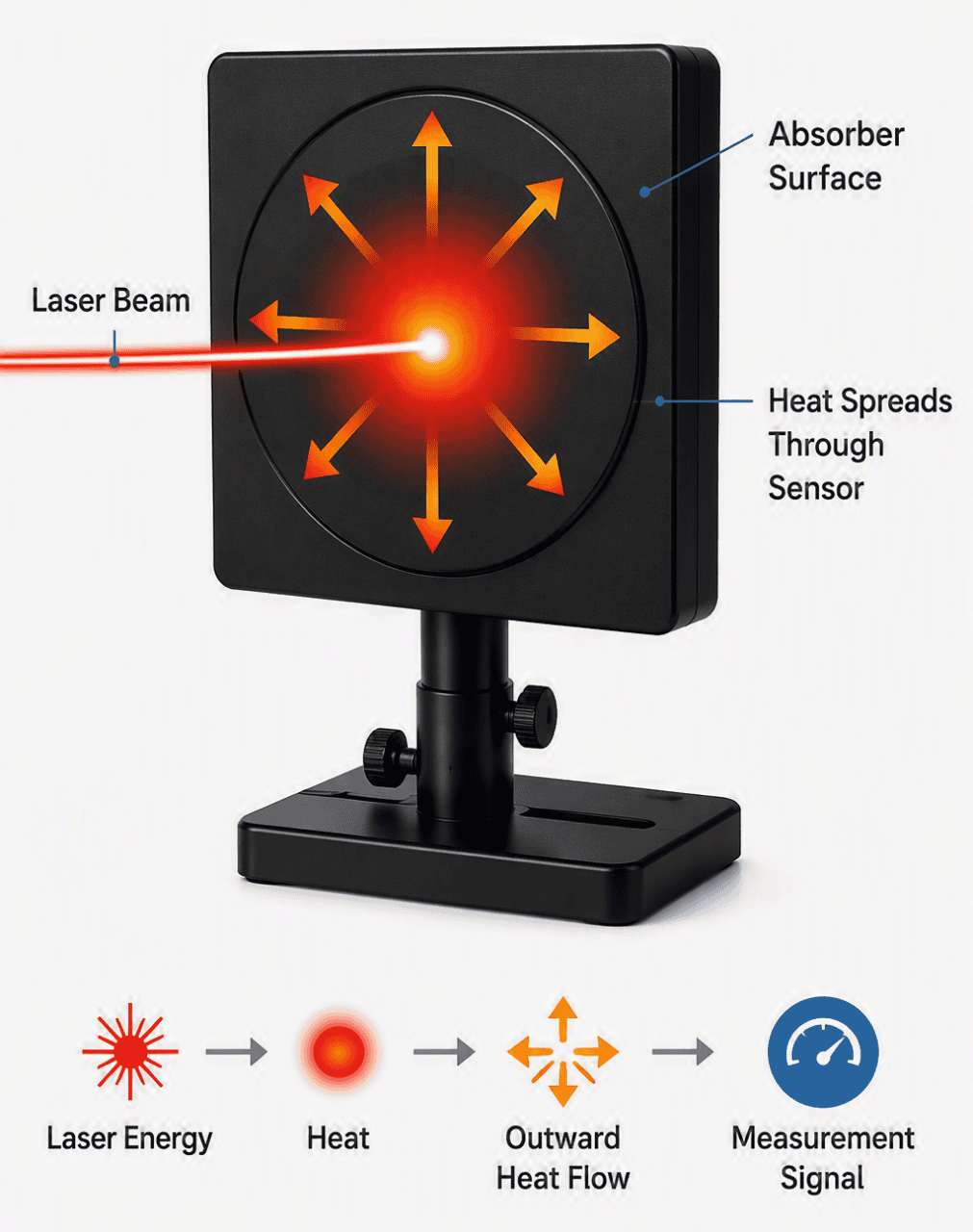
A thermal sensor absorbs incoming laser radiation on an absorber surface. The absorbed light becomes heat. That heat creates a temperature difference inside the sensor, and the sensor converts that temperature difference into an electrical signal.
One common detection mechanism is thermoelectric detection. In simplified terms, dissimilar metals are connected in a way that produces a voltage when there is a temperature difference between two points. The voltage is proportional to the heat flow caused by the absorbed laser power.
Because the raw signal is not automatically an absolute measurement, calibration is essential. During calibration, the relationship between the sensor signal and the incident laser power is characterized. That allows the instrument to display an actual power reading rather than only showing that power is increasing or decreasing.
Radial and axial thermal configurations
Thermal sensors can be built in different configurations.
In a radial configuration, the beam is absorbed near the center of a circular absorber. The resulting heat spreads outward. The instrument measures the temperature difference between the hotter inner region and the cooler outer region.
In an axial configuration, heat flows from front to back. This configuration can be more sensitive, which makes it useful for lower power levels. The tradeoff is that it may be slower.
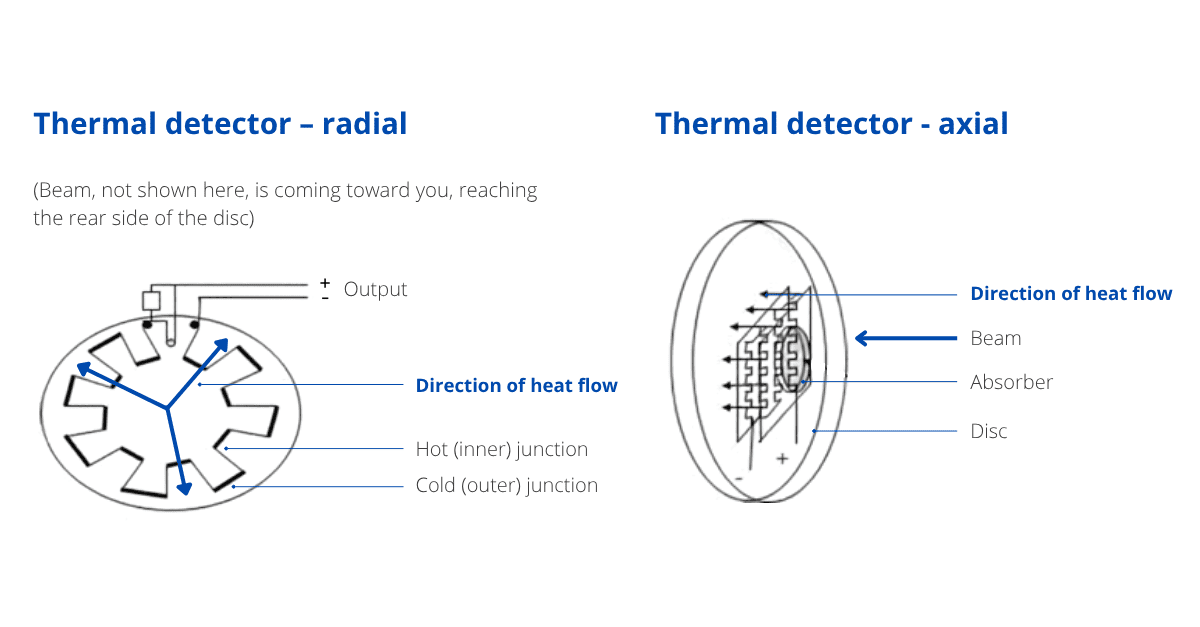
These configurations reflect a basic engineering reality: every design involves tradeoffs. Sensitivity, response time, maximum power, durability, aperture size, and cost are all related to the final sensor design.
Response time: why thermal sensors are not instantaneous
A thermal sensor does not respond instantaneously.
After the laser beam reaches the absorber, the resulting heat must spread through the sensor before the detector signal rises in response. The response time depends on the physical and thermal structure of the sensor.
In many thermal sensors, the physical response time is on the order of seconds – the sensor may take several seconds to reach its final value. However, because the response curve of a given sensor (the “shape” of the signal over time as it rises from zero to its final value that represents the given power) is predictable, the instrument can use a predictive algorithm to estimate the final reading before the full physical response is complete.
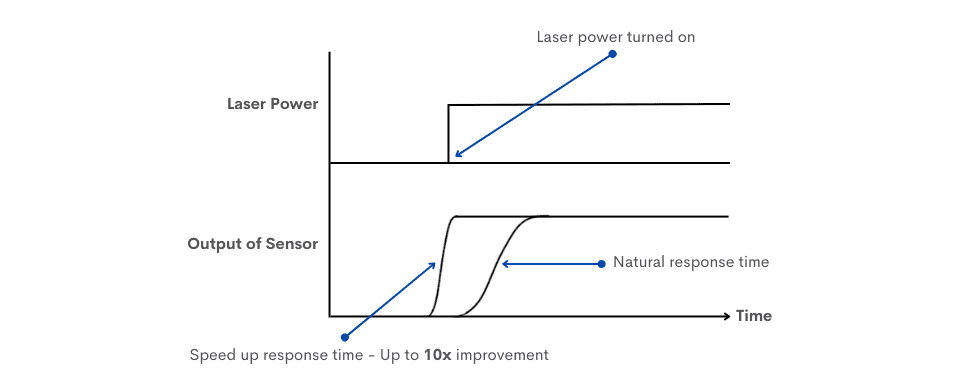
This helps the user receive a stable reading faster than waiting for the complete thermal process to settle.
| Measurement Need | Thermal Sensor Suitable? |
| Continuous Power | ✅ |
| Single-Shot Energy | ✅ |
| High Average Power | ✅ |
| Every Pulse in Fast Pulse Train | ❌ |
| Ultra-Fast Response | ❌ |
Measuring single-shot energy
Thermal sensors can also be used to measure the energy of a single pulse.
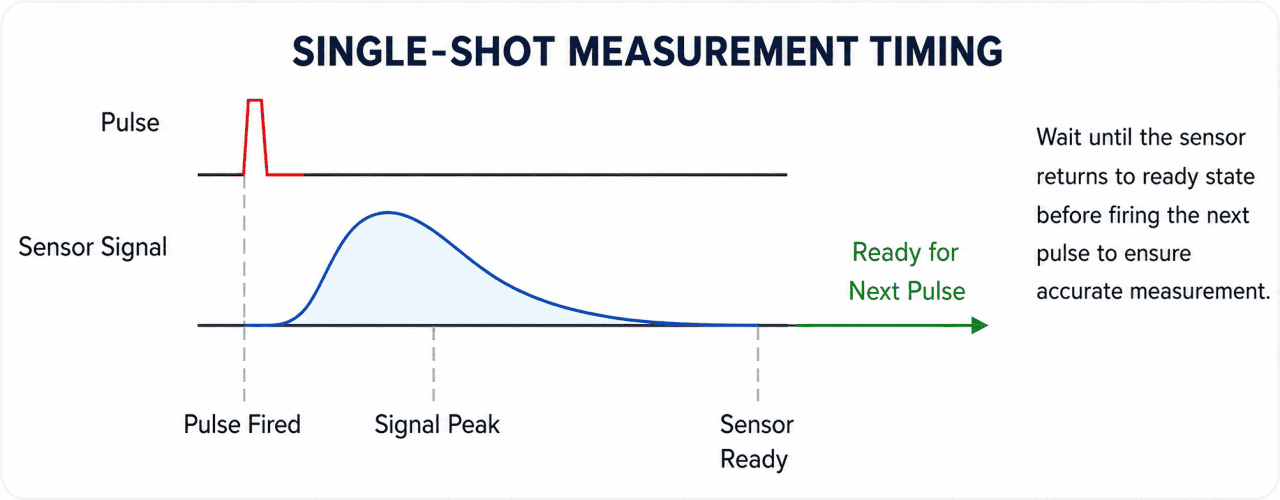
When a single pulse is fired, the absorber turns the pulse energy into heat (as it does when it absorbs a continuous beam). The heat “pulse” reaches the thermopile detector, the signal rises, reaches a maximum, and then falls back down as the heat dissipates. The area under that signal curve corresponds to the total energy in the pulse.
The instrument performs the integration automatically. The user does not need to calculate the area under the curve manually. This method is useful for single-shot energy measurements, but – because of the seconds-long response time – it is not suitable for measuring every pulse in a fast repetitive pulse train. If another pulse arrives before the sensor has returned to readiness, the sensor may interpret the combined heat input as one longer event or produce an incorrect result. The user needs to wait until the instrument is ready before firing the next pulse.
High-power measurement from short exposures
The same single-shot principle can also be used for some very high-power measurements.
A sensor may not be designed to tolerate continuous exposure to a very high-power beam. However, it may be able to tolerate that beam for a short, controlled exposure. If the exposure time is known, the instrument can measure the energy delivered during that short exposure and calculate power from energy divided by time.
This approach can be valuable in industrial environments where the laser power is very high, but continuous exposure would require a larger or more complex measurement setup (e.g. water cooling). It allows high-power lasers to be measured intermittently, provided that (a) the exposure is short enough that the total amount of absorbed heat is low enough that the sensor won’t overheat, and (b) there is enough time between exposures for heat to dissipate.
In automated production environments, such as factory-floor systems, this kind of measurement can be integrated into a larger control network rather than displayed only to a human user.
Absorbers and spectral range
The absorber material is a critical part of the sensor. It affects both the spectral range and the durability of the sensor.
Different materials absorb different wavelengths differently. That means the absorber helps determine which wavelengths the sensor can measure accurately. It also affects the sensor’s power density and energy density limits, commonly referred to as its damage threshold.
There are two broad absorber concepts:
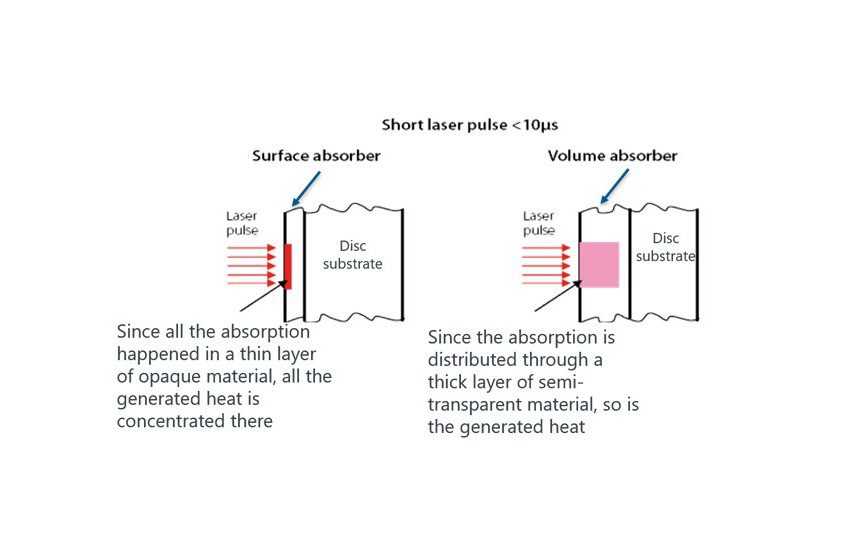
– Surface absorbers, where light is absorbed near the surface of an opaque material
– Volume absorbers, where light is absorbed gradually through a thicker layer of semi-transparent material
Surface absorbers can be suitable for many applications, but very short, high-energy-density pulses can concentrate heat in a thin surface layer, and if the material is not able to withstand that it may be damaged. A volume absorber spreads absorption through a thicker material, which can improve durability for certain short-pulse conditions. The tradeoff is that volume absorbers may not be ideal for high average power (although there are some that are; those, of course, have other tradeoffs…).
The maximum average power density a given absorber can handle is not a single fixed number; it is lower at higher powers. Sensors meant for measuring high-power beams sometimes use a design trick to overcome this limitation and maximize their damage threshold: They reduce power density by spreading the beam before it reaches the absorber. For example, a diffuser or a reflective cone can enlarge the beam before it reaches the absorber surface, reducing the power density and helping the sensor survive high-power conditions.
Again, the measurement task determines the right sensor design.
Cooling and power handling
The sensor body determines how much heat can be dissipated. At low powers, heat dissipation by simple conduction from the sensor body into the air is often enough. At medium powers, forced air cooling may be needed. At higher powers, water cooling may be required.
Final thought
Thermal sensors are built around a simple measurement idea, but the engineering behind them is sophisticated. The absorber, detector geometry, thermal conductivity, response algorithm, cooling method, and damage threshold all determine how the sensor performs.
For users, the key to choosing the right sensor is to define the laser and measurement conditions clearly: wavelength, power, energy, beam size, pulse length, repetition rate, and expected power or energy density. With that information, a thermal sensor can provide reliable measurements across a wide range of laser applications, and provide good performance for many years of use.
Frequently Asked Questions
A thermal laser power sensor measures laser power by absorbing the incoming laser beam and converting the absorbed energy into heat. That heat creates a temperature difference inside the sensor, which is then converted into an electrical signal that can be calibrated to display laser power accurately.
A thermopile sensor is a type of thermal detector that uses multiple thermoelectric junctions connected together to generate a voltage in response to a temperature difference. In laser power measurement, thermopile sensors detect the heat produced when laser energy is absorbed by the sensor’s absorber surface.
Thermal sensors can measure a wide range of laser wavelengths and are capable of handling power levels that may be too high for more sensitive detector technologies. This makes them useful for many moderate- and high-power laser measurement applications.
Yes. Thermal sensors can measure the energy of individual laser pulses. The pulse energy is absorbed as heat, creating a detector response that rises and falls over time. The measurement instrument integrates this response to calculate the total pulse energy automatically.
Not usually. Thermal sensors require time for heat to propagate through the sensor and dissipate after a measurement. If pulses arrive too quickly, the sensor may not fully recover between events, which can affect measurement accuracy.
In a radial thermal sensor, heat flows outward from the center of the absorber toward the edges. In an axial thermal sensor, heat flows through the thickness of the sensor. These different designs involve tradeoffs between sensitivity, response time, power handling, and other performance characteristics.
Because thermal sensors measure heat, the absorbed energy must physically travel through the sensor before a stable reading can be produced. Although the underlying thermal process may take several seconds, modern instruments often use predictive algorithms to estimate the final reading more quickly.
Yes. Thermal sensors are commonly used for high-power laser measurement. Their power handling capability depends on factors such as absorber design, cooling method, beam size, wavelength, exposure duration, and power density.
The absorbed laser energy becomes heat that must be dissipated. Depending on the power level being measured, a sensor may rely on natural air cooling, forced-air cooling, or water cooling to maintain accurate measurements and avoid overheating.
A thermal sensor’s damage threshold is the maximum energy density or power density it can withstand without damage. Damage threshold depends on factors such as absorber material, beam size, wavelength, pulse duration, and exposure conditions.
Surface absorbers absorb laser energy near the surface of an opaque material, while volume absorbers absorb energy throughout a thicker semi-transparent material. Each approach offers advantages and tradeoffs.
Selecting the right sensor requires understanding your laser’s:
▫ Wavelength
▫ Average power
▫ Pulse energy
▫ Pulse duration
▫ Repetition rate
▫ Beam size
▫ Power density or energy density
Matching these parameters to the sensor specifications helps ensure accurate and reliable measurements.
The Ophir Sensor Finder takes all these factors into consideration to help you select the optimal sensor for a given set of laser parameters.