Measuring laser power can tell you a lot about a laser system, but it may not tell you the whole story.
Changes in beam position or beam size can reveal alignment issues, pointing instability and other changes in a system even when measured power remains within expectations. During our recent webinar, Measuring Laser Power, Position and Size: A Practical Approach, we explored how simultaneous measurement of these parameters can provide additional insight into laser performance.
The webinar generated practical questions about spot size, focus, measurement accuracy, beam profiling and pulsed lasers. Below, we answer several of the questions with the broadest relevance to engineers and technicians working with laser measurement systems.
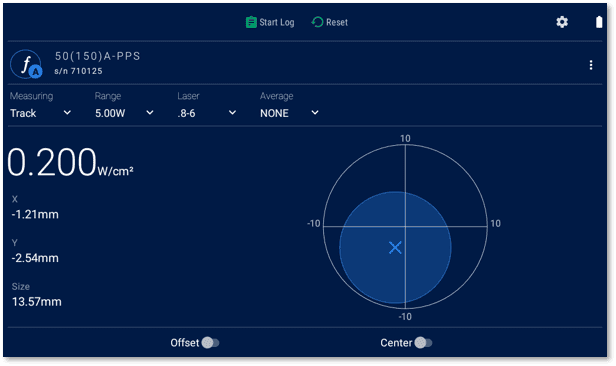
What is laser beam position, and why measure it?
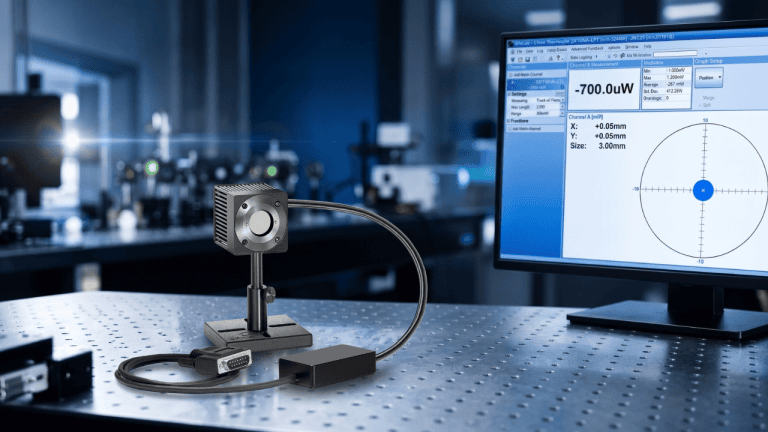
Beam position describes the location of the beam relative to a known reference point. In practice, this is often expressed through the beam centroid, the position representing the center of the measured beam.
Monitoring position alongside power can be particularly useful during system alignment. An adjustment to an optomechanical system may leave the measured power looking normal while causing the beam to shift. Tracking both parameters can reveal that movement.
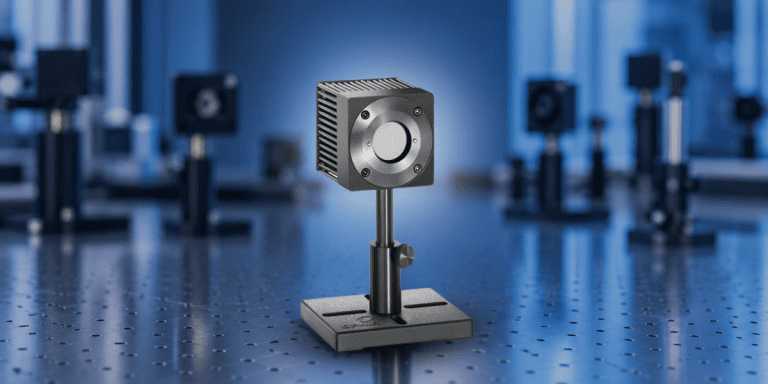
For applications involving alignment or pointing stability, explore Ophir BeamTrack laser power, position and size sensors and see how to monitor laser position and beam size over time with BeamTrack and StarLab.
How small a laser spot can BeamTrack measure?
The answer depends on the specific sensor. As a general indication provided in the technical follow-up, the minimum spot size is approximately 1.5 mm, with approximately ±5% accuracy for a centered beam with a Gaussian intensity profile. The applicable specification should always be confirmed for the individual sensor model.
If the application involves a significantly smaller beam or a focal spot, a beam profiling solution may be needed instead.
For smaller beams or applications requiring full spatial characterization, review Ophir laser beam profiler solutions.
Can I measure laser power or beam size at focus?
For power measurement, measuring directly at focus is generally not recommended because the concentrated beam can produce power or energy density high enough to exceed the sensor damage limit.
For beam-size measurement, sharp focus presents an additional challenge. PPS sensors can struggle to produce accurate results for beam sizes below 1 mm. If the application requires focal-spot measurement or a detailed view of the beam distribution, a suitable beam profiling solution is the better approach.
Before selecting a measurement location:
- Keep the beam within the sensor measurable range.
- Make sure the complete beam is captured.
- Keep power or energy density safely below the sensor damage limit.
For focused beams of 50 µm or smaller, see the Ophir Near Field Analysis Beam Profiler.

Is it better to measure laser power before or after focus?
For basic power or energy measurement, the key considerations are capturing the entire beam and keeping the beam within the sensor measurable range. The measurement can be made before or after focus if those conditions are met and the beam power density remains below the sensor damage limit.
When possible, measuring before focus may be preferable. In addition to the damage risk at focus, very high power or energy density can sometimes cause scattering effects around the focal region. Always check the sensor specified maximum power density and maximum energy density before measuring.
How can I improve the accuracy of a laser power measurement?
Several fundamentals help improve measurement accuracy:
- Use the appropriate sensor and meter settings for the laser source.
- Make sure the complete beam is captured by the sensor.
- Avoid focusing the beam so tightly that power or energy density exceeds the sensor damage limits.
- Center the beam appropriately on the active area.
For many setups, a beam diameter of approximately 50% of the active-area diameter provides useful margin to help capture light extending beyond the reported beam diameter, particularly with Gaussian beams or beams with high mode content.
For additional information on calibration accuracy, measurement uncertainty and traceability, read Ophir Calibration Procedure and Traceability.
Does BeamTrack replace a beam profiler?
No. BeamTrack and beam profilers provide different levels of information.
BeamTrack measures laser power and beam position, and PPS models also measure beam size. It does not measure the complete distribution of power across the beam cross-section. For a symmetrical Gaussian beam, the size measurement can provide a useful absolute result. With a non-Gaussian beam, monitoring whether the beam is getting larger or smaller can still be valuable when the trend matters more than a complete spatial profile.
A laser beam profiler is appropriate when the application requires detailed information about the spatial distribution, beam shape, small focal spots or other full-profile measurements. For alignment, pointing stability or production checks that need power, position and size without a complete profile, BeamTrack PPS and QUAD sensors may provide the information required.
Can a beam profiler measure beam diameter?
Yes. An Ophir beam profiler can measure beam diameter when it is configured and used correctly. The distinction is the amount of information the application requires. A full beam profiling system characterizes the spatial profile, while a PPS measurement provides power, position and size without the full cross-sectional distribution.
Explore camera-based BeamGage laser beam profilers or NanoScan scanning-slit beam profilers for applications requiring detailed beam characterization.
Can BeamTrack be used with pulsed lasers?
It depends on the application, sensor and measurement being performed. BeamTrack is based on thermal sensing, so its response has a thermal time constant. The appropriate sensor and exposure conditions depend on the laser specifications and on whether the requirement is average power, pulse energy or instantaneous peak power.
For a practical overview, read Can I Use My BeamTrack Sensor with a Pulsed Laser? and use the Laser Peak Power Calculator when peak-power estimation is relevant.
What does beam pointing stability look like in practice?
Pointing stability describes how the beam position changes over time. With BeamTrack and StarLab, the changing position of the beam centroid can be displayed as a visual history together with power and positional information. This helps users see not only where the beam is at a given moment, but how stable that position has been during the measurement period.
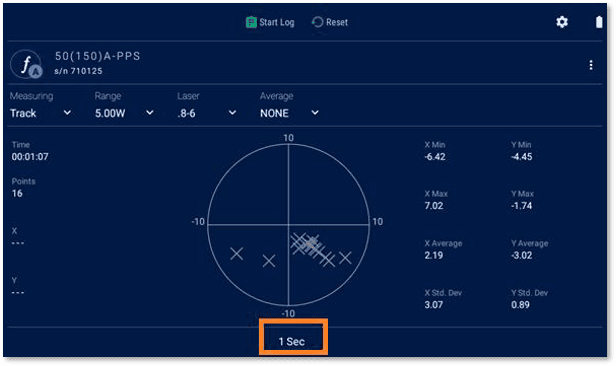
See the practical article on monitoring laser position and beam size over time in StarLab and watch Beam Pointing Stability Measurement with BeamTrack and StarLab.
What should I measure: power, position, size or a full beam profile?
Start with the question the application needs to answer:
- Power: may be sufficient when the requirement is simply to quantify laser output.
- Power + position: adds information about beam alignment and the location of the beam centroid.
- Power + position + size: adds information about changes in beam dimensions and stability.
- A full beam profile: is appropriate when detailed spatial information about the distribution of power is required.
Compare BeamTrack laser position sensors with the broader range of Ophir laser beam profilers based on the information the application actually requires.
Have another laser measurement question?
The questions above came from engineers and laser users who joined our Measuring Laser Power, Position and Size: A Practical Approach webinar.
If you are working on a laser measurement challenge, tell us about your laser, measurement requirements and application.
You can also watch the full webinar on demand.