How adjustable ring/core beams help manufacturers tune energy delivery for advanced welding and additive manufacturing.
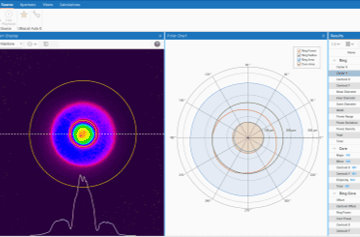
Two energy zones, one controllable process
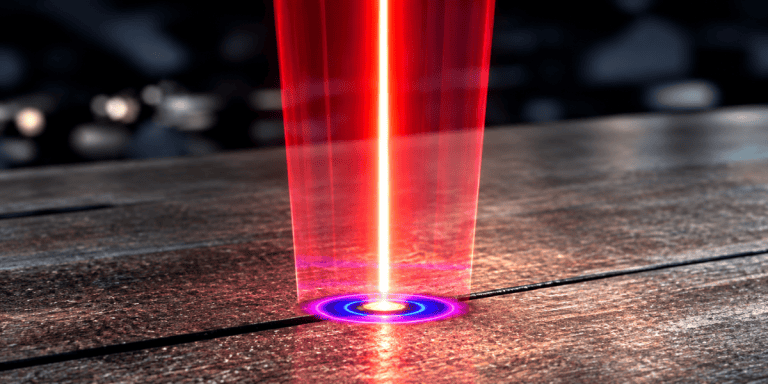
A ring/core beam distributes laser power between a high-intensity central core and a surrounding annular ring. The core supplies the concentrated energy used for processing, while the ring conditions the surrounding material. Adjusting the balance between these regions changes how energy reaches the workpiece, creating a practical way to optimize stability, quality, and throughput.
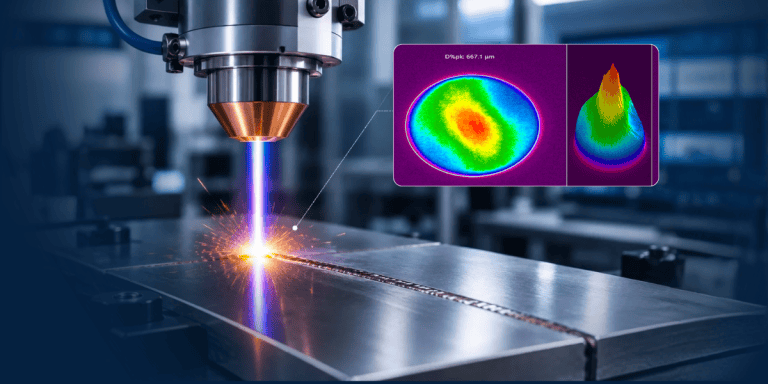
| LASER WELDING The ring preheats and conditions nearby material, while the core provides the higher power density for joining. The combined profile can reduce spatter and support a cleaner, more uniform weld bead. | ADDITIVE MANUFACTURING Adjustable ring and core profiles help balance feature precision and build rate. Controlled energy distribution can support stable powder-bed fusion, lower spatter, and improve process efficiency. |
Why total power is not enough
A ring/core profile behaves like two overlapping beams. A power meter reports the total energy, but cannot show how much is in each region, whether the core is centered in the ring, or whether the ring is uniform. Camera-based beam profiling adds the spatial information needed to verify the delivered beam at the measurement plane.
The measurements that connect beam shape to process performance
- Ring inner, mean, and outer diameters, plus ring width
- Core size, shape, centroid, and ellipticity
- Ring-to-core offset and centroid offset
- Ring/core power distribution and region-specific power density
- Angular ring uniformity, radius variation, and thickness variation
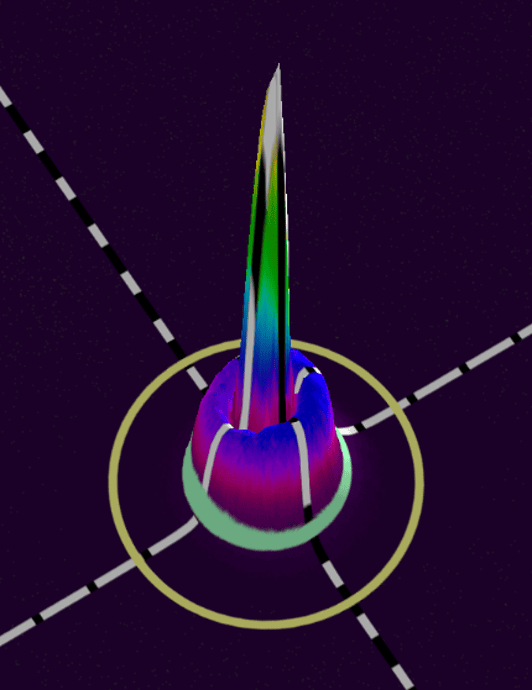
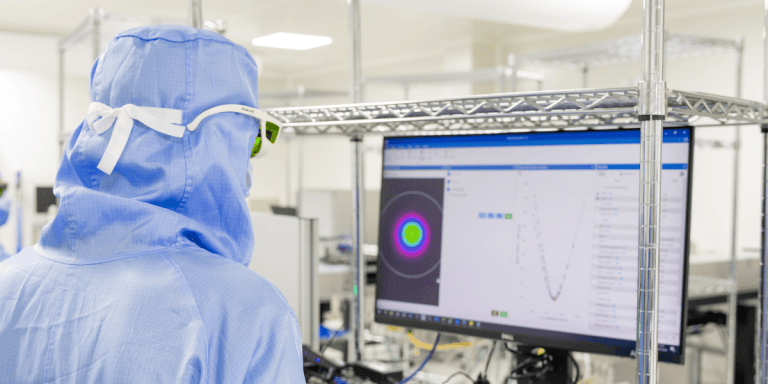
See the Ring and Core in Real Time
Dedicated analysis turns a complex, two-region beam into actionable measurements for alignment, qualification, and process development.
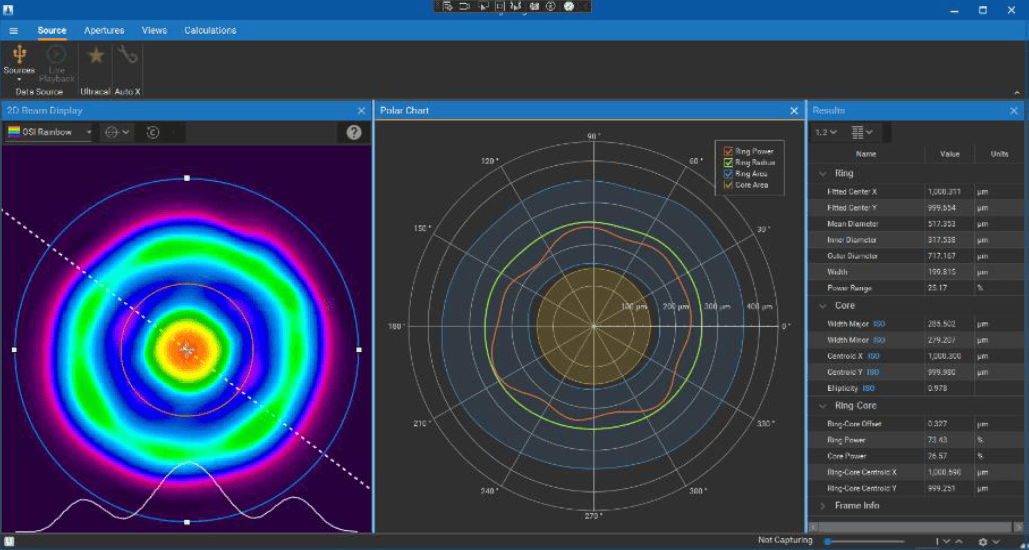
Purpose-built separation and analysis
BeamGage Ring-Core is designed for beams containing concentric annular and core elements. Patent-pending algorithms isolate the two regions and calculate specialized results for beam size, alignment, power distribution, and quality. The Automatic Ring-Core Aperture can use a Minima method for clearly separated regions or a Curvature method when the transition between ring and core is less distinct.
| MEASURE Ring inner/mean/outer diameter and width; core major/minor width and ellipticity; ring and core centroids; region totals and calibrated power or energy. | ALIGN Offset from ring center to core centroid, centroid-to-centroid offset, and a Polar Chart showing core position, ring radius, thickness, and angular power variation. |
| EVALUATE Power Range and Power Deviation quantify ring uniformity. Radial intensity correction compensates for the increasing number of pixels at larger radii. | MODEL Heat Simulation filters small-scale power variations according to thermal diffusivity and travel speed, helping focus analysis on defects more likely to affect the process. |
Tools that support repeatable measurement
- Ultracal background correction isolates the beam signal from camera noise and ambient light.
- AutoX provides dynamic exposure, gain, black-level adjustment, and baseline subtraction when conditions change.
- Optical Scaling reports spatial results at the original beam plane after expansion or reduction optics.
- Power/Energy calibration combines the measured spatial distribution with an entered or separately measured total.
- The frame buffer enables review of previously captured frames, while .rcData and .bgData files support offline analysis.
- BeamMaker supplies simulated Ring/Core data for training, workflow development, and sensitivity-to-noise testing.
Ring Core BeamGage software Link
The Ophir Ring/Core Measurement Ecosystem
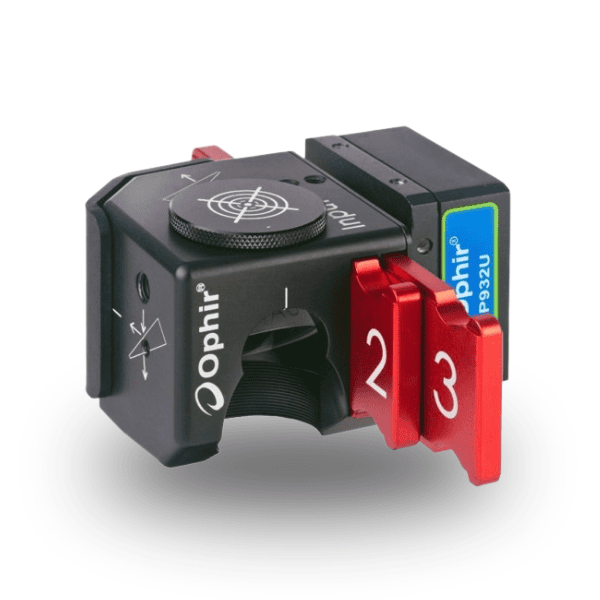
Select the measurement path according to beam size, wavelength, power level, focal geometry, and whether profiling is required at the work plane or through the caustic.
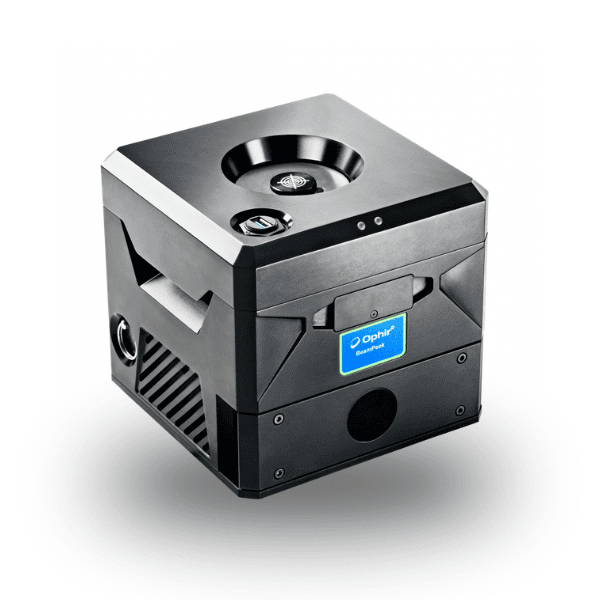
Compatible beam-profiling cameras with a BeamGage Professional license
SP204S | SP402S | SP932U | SP504S
Solutions for high-power and focused beams
| LBS-300s-NIR: UP TO ~400 W For beams up to 15 mm, Ophir specifies 10 mW to approximately 400 W. Under stated Gaussian-beam and attenuation conditions, maximum power may reach 1,000 W. Product: ophiropt.com/en/f/lbs-300s-beam-splitter | LBS-300HP-NIR: 5 kW For high-power NIR lasers, Ophir specifies operation up to 5 kW and power-density attenuation up to 15 MW/cm². Product: ophiropt.com/en/f/lbs-300hp-nir-beam-splitter |
| BEAMPEEK™ Integrated high-power analysis compatible with BeamGage Ring-Core, including profile, focal spot, position, beam caustic, and power measurement. | FOCAL SPOT ANALYZERS Solutions for characterization at or around the focused work plane when focal spot behavior and beam caustic are central to qualification. |
ONE ANALYSIS WORKFLOW, FROM BEAM DEVELOPMENT TO PROCESS QUALIFICATION