Lithium niobate is a leading material for integrated optics used in quantum and non-quantum optical applications. Due to its nonlinearity, it is especially valuable in the fabrication of electro-optical devices for quantum state generation and manipulation. Especially, Lithium niobate nonlinear waveguide networks photonic structures based on the crystalline material – are uniquely suited for quantum state generation. To achieve a squeezed quantum state, a laser is used as the pump to drive a nonlinear parametric process. The laser light generates correlated photon pairs at half of its frequency, where the fluctuation in one quadrature (phase or amplitude) is reduced while the other increases.
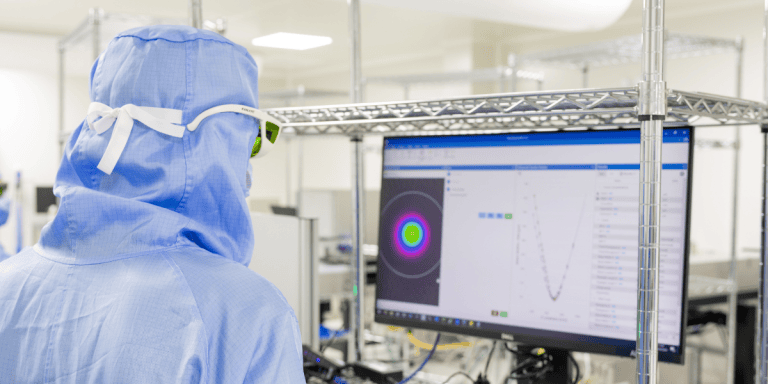
With the interaction of fields at different wavelengths, it is core in the development process to know the beam profile of all modes. Together with the National Institute for Nuclear Physics (Istituto Nazionale di Fisica Nucleare INFN), Italy, a team of researchers at University of Trento used an Ophir® laser beam profiler with BeamGage® software to characterize the output mode of an integrated quantum device.
Integrated photonics
Similar to microelectronics, which manipulate electrons, integrated photonics combine waveguides, modulators, lasers, and detectors on a single microchip to manipulate light. This miniaturization is a key driver of quantum technologies and quantum computing. Electro-optic devices based on lithium niobate integrate multiple functionalities on one chip, including nonlinear optical conversion for generating single photons and squeezed vacuum via parametric down-conversion, as well as amplitude and phase modulation through the electro-optic effect.
A team at the University of Trento under the guidance of Prof. Mirko Lobino developed an integrated circuit in lithium niobate fabricated using the proton exchange technique that is capable of generating, manipulating, and measuring quantum state of light at telecom wavelength.
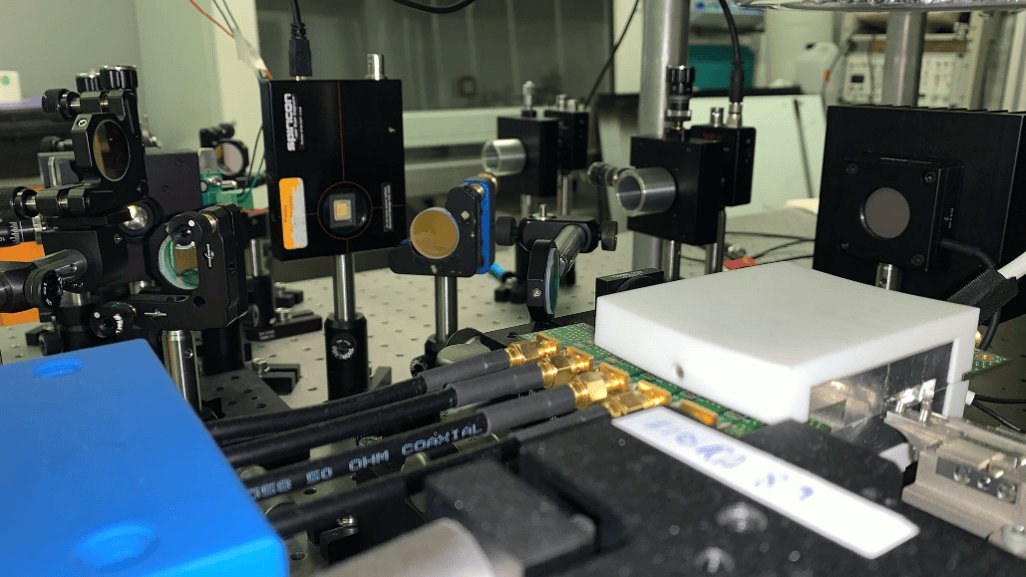
Characterize the output
Waveguides are the core of the newly developed integrated photonics device. To ensure the efficiency of their nonlinear interactions, such as the generation of squeezed light photons, the spatial mode of the pump beam is supposed to overlap with the waveguide’s mode which has half the frequency. Additionally, the mode is supposed to overlap with the mode of a standard single-mode optical fiber. This ensures the efficient coupling of the photons into the fiber. In the development phase, overlap is simulated theoretically but these calculations only give an estimate of the real nonlinear efficiency in the device.
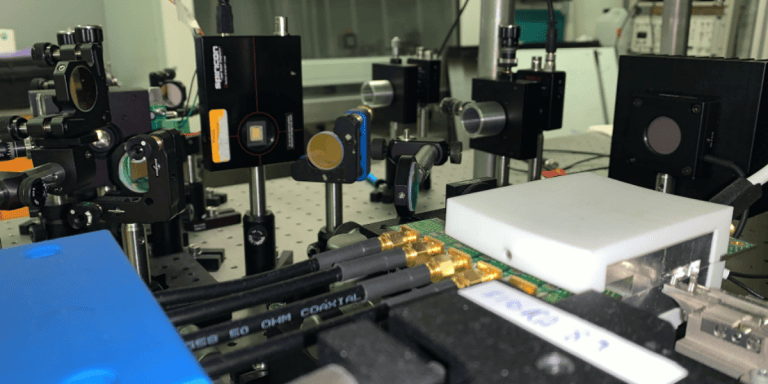
The production process of a lithium niobate waveguide requires dedicated knowledge and specialized production facilities. Once the waveguide is produced, it is essential to check the output mode of the device. This is when MKS measurement devices enter the stage: an Ophir phosphor coated camera together with the Ophir BeamGage software are used to characterize the output mode of the integrated device. Prof. Mirko Lobino explains: ‘This characterization is important to verify whether our waveguides are single-mode, whether the mode has good overlap with standard optical fibers, and to calculate the overlap with the pump mode in order to estimate the efficiency of spontaneous down-conversion.’
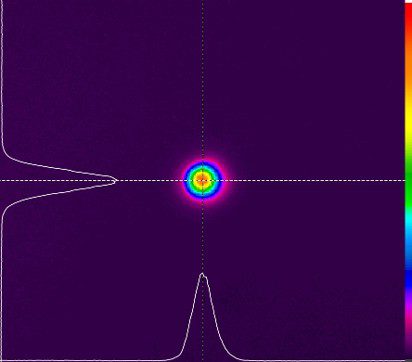
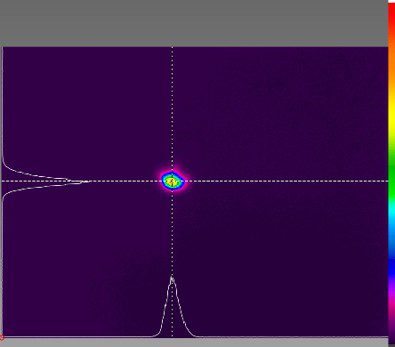
The monolithic nature of these devices as shown in the profile means that the correct phase can be stably realized in what would otherwise be an unstable interferometer, greatly simplifying the task of implementing sophisticated photonic quantum circuits.
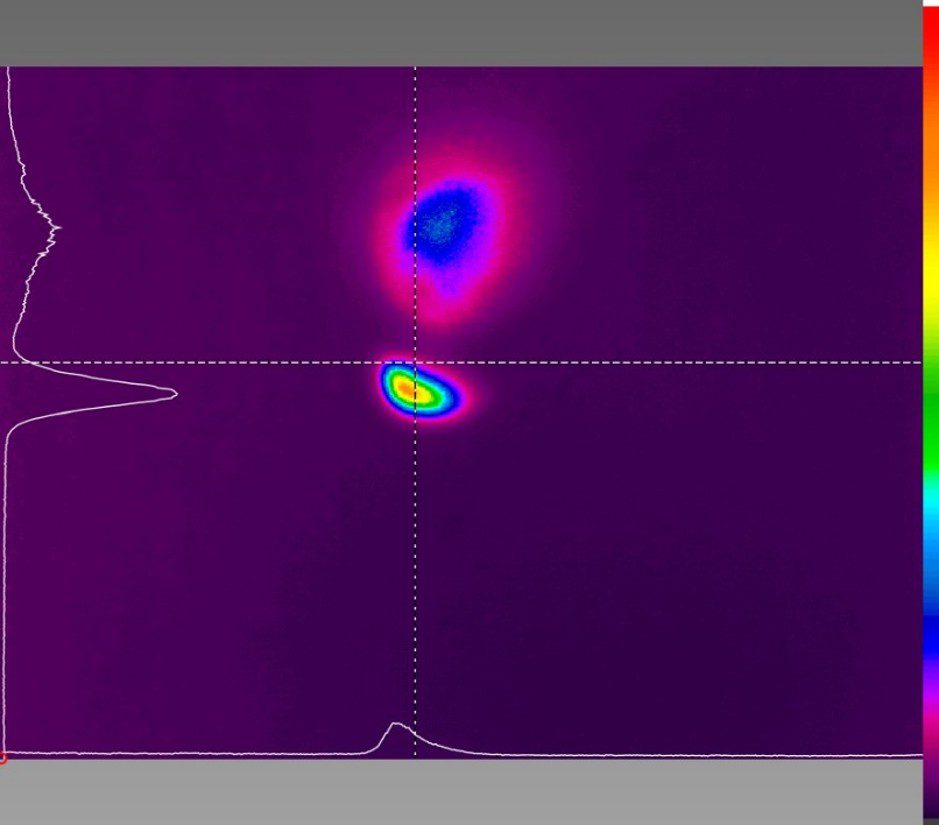
Beam diagnostics in the long run
While the nonlinearity of lithium niobate presents a major advantage for its use in quantum technologies, the material is considered more challenging to integrate and less robust compared to silicon photonics. Therefore, it is essential to monitor the behavior of the integrated photonic chip over an extended period of time. In addition to the initial measurements that serve as the quality inspection of a produced lithium niobate waveguide, the diagnostical part covers the long-term characteristics of the device. The researchers measure the output power of the waveguide on a regular basis. As soon as the power decreases, the mode profile is taken with the Ophir beam profiler to identify changes in the optical characteristics of the beam.
Source: Integrated photonic platform for quantum information with continuous variables | Science Advances
University of Trento – Industrial Engineering
The Department of Industrial Engineering at the University of Trento performs research, training, and teaching in the sectors of industrial engineering, in particular in mechanics, mechatronics, materials engineering, electronic-and micro-electronic systems, management information systems, and optimization methods and models to support decision making.
The research objectives of the department regard the structure of materials, their features and applications, new materials and technologies, automation systems of processes and machineries, energy production and storage, the design and implementation of mechanical/electronic integrated devices, with specific functions in innovative applications, the optimization of products and processes. The department cooperates with various national and international research institutions, and is engaged in basic and applied research projects, with a strong connection to the industrial world.