As industrial lasers become more powerful and beam delivery becomes more sophisticated, measuring total laser power alone may not tell the whole story.
In applications such as laser welding and additive manufacturing, process performance also depends on where that power is delivered, how it is distributed across the beam, where the beam reaches focus, and how those characteristics change over time.
That makes beam characterization an increasingly important part of understanding and controlling high-power laser processes. The challenge is not simply answering “How much power does my laser produce?” It is understanding what the laser beam is actually doing at and around the workpiece.
Want to See High-Power Beam Diagnostics in Practice?
The upcoming webinar moves from measurement questions to practical examples, demonstrations, and real-world application considerations.
November 25, 2026 | Choose the session that works best for you
APAC / Europe
10:00 AM Israel Time | 9:00 AM CET | 4:00 PM Singapore | 5:00 PM Japan/Korea
Americas / Europe
6:00 PM Israel Time | 5:00 PM Central Europe | 11:00 AM US Eastern | 8:00 AM US Pacific
Beam Shape Changes the Measurement Challenge
Traditionally, many industrial lasers have been characterized using relatively simple beam geometries. Today, beam shaping technologies provide much greater control over the way laser energy reaches the material.
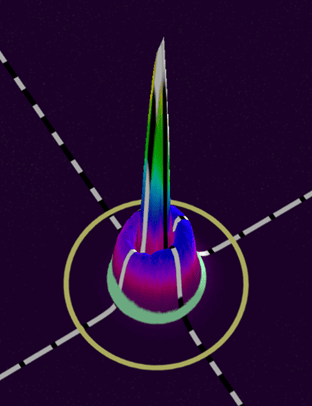
Ring/core beams are a good example.
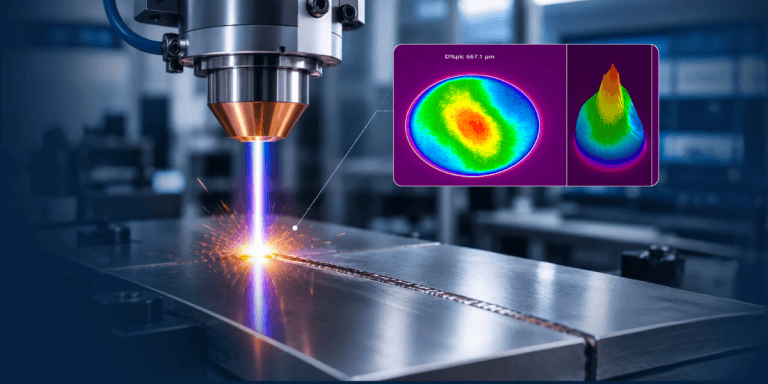
In a ring/core profile, laser power is divided between a central core and a surrounding ring. In laser welding, the lower power density of the ring can prepare the material while the higher power density of the central core performs the joining process. This combination is designed to reduce spatter, support process stability, and produce a cleaner, more uniform weld bead. Ring/core beam technologies are also increasingly used in additive manufacturing.
But this flexibility creates a new measurement challenge.
A conventional power meter can measure total laser power, but it cannot separately show how that power is distributed between the ring and the core. To understand the beam at the working plane, the beam profile itself must be characterized.
Why Power Density Matters
Consider two beams delivering the same total laser power. If those beams have different spot sizes or different spatial power distributions, the interaction with the material can be very different.
Power density depends on both laser power and the cross-sectional area over which that power is distributed. In a ring/core beam, for example, the larger diameter of the ring means that its power density can be lower than that of the core even when the nominal power delivered to the two regions is the same.
Beam profiling makes it possible to define these regions and evaluate parameters that total power measurement alone cannot provide:
- Ring/core offset: Are the centers of the core and ring properly aligned?
- Ring/core power ratio: How is laser energy distributed between the two regions?
- Ring uniformity: How evenly is power distributed around the ring?
- Beam dimensions: What are the diameters and areas used to determine power density at the working plane?
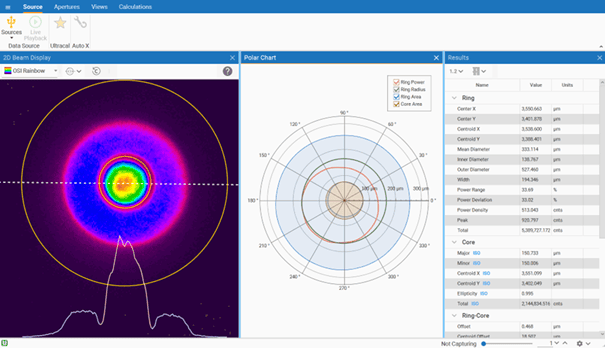
These measurements help turn a single power value into a more complete picture of how laser energy is actually being delivered.
But Beam Shape Is Only Part of the Story
Spatial power distribution tells us what a beam looks like at a particular location. High-power laser diagnostics may also need to answer another question: What happens to the beam as it propagates through focus?
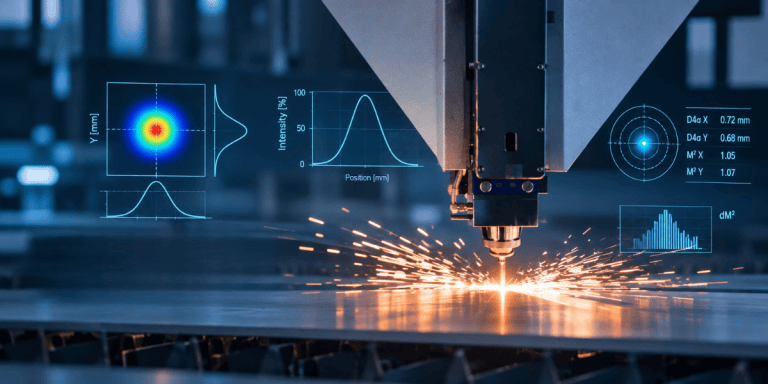
Parameters such as waist size and location, Rayleigh length, M² or beam parameter product (BPP), and focal shift provide information that a single-point measurement cannot capture.
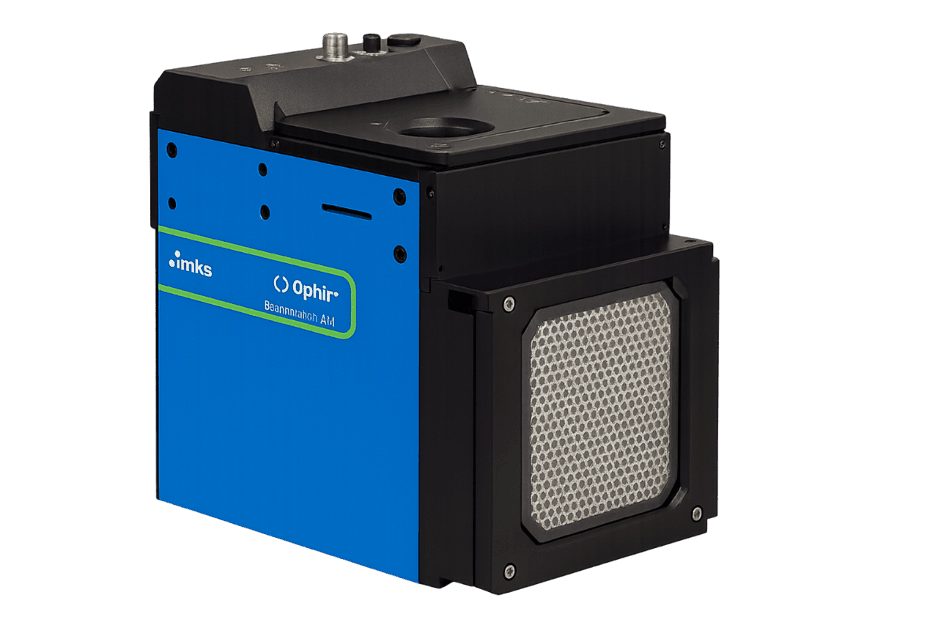
BeamWatch AM uses Rayleigh scattering of laser light by air molecules to observe the beam caustic. The system can simultaneously measure the near field, focus, and far field of the beam, along with laser power. The method also supports propagation and M² measurements in accordance with ISO 11146.
What Happens During Laser Startup?
There is another dimension that is easy to overlook: time.
The focal position of a high-power laser system does not necessarily remain unchanged as the system reaches operating conditions. Because BeamWatch AM measurements are performed in real time, focal shift occurring during the critical startup seconds can be measured and reported.
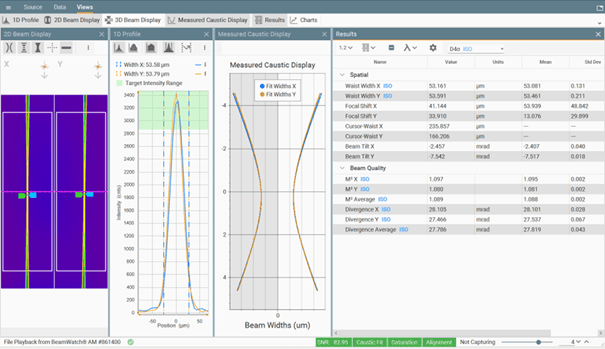
This turns beam characterization from a static snapshot into a way of observing how the beam behaves dynamically. For laser welding, additive manufacturing, and other demanding high-power processes, these measurements can provide valuable information when evaluating the laser system and the consistency of the beam delivered to the process.
From “How Much Power?” to “What Is the Beam Doing?”
None of this makes laser power measurement less important. Rather, it shows why power measurement and beam characterization answer different questions.
- A power measurement tells you how much laser power is being delivered.
- Beam profiling can show how that power is distributed spatially.
- Beam propagation measurements can show where the beam reaches focus and how it behaves around that point.
- Real-time measurements can reveal whether those characteristics change over time.
For increasingly sophisticated high-power laser processes, bringing these measurements together can provide a more complete understanding of what is actually happening between the laser source and the workpiece.
See High-Power Laser Beam Diagnostics in Practice
What does this look like in a real measurement environment? And which diagnostic approach should be used for different high-power laser applications?
In our upcoming webinar, Ophir experts will explore practical approaches to beam profiling and high-power laser diagnostics, including measurement considerations for applications such as laser welding and additive manufacturing.
We will examine how different beam parameters can be measured and what those measurements can reveal about the performance of a high-power laser system.
Ready to Take a Closer Look?
Join the webinar to explore practical approaches to beam profiling, focus characterization, and high-power laser measurement.
November 25, 2026 | Choose the session that works best for you
APAC / Europe
10:00 AM Israel Time | 9:00 AM CET | 4:00 PM Singapore | 5:00 PM Japan/Korea
Americas / Europe
6:00 PM Israel Time | 5:00 PM Central Europe | 11:00 AM US Eastern | 8:00 AM US Pacific