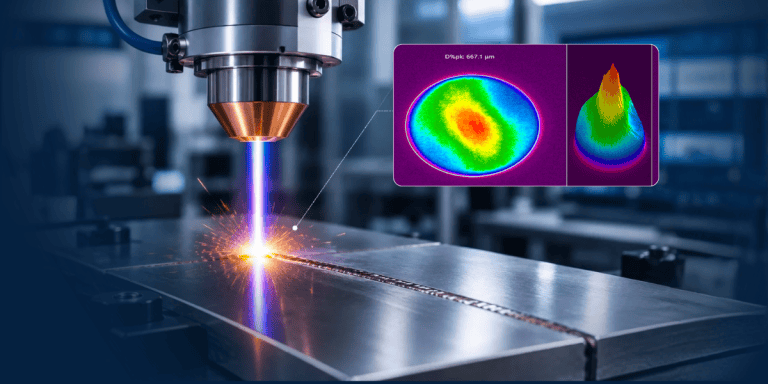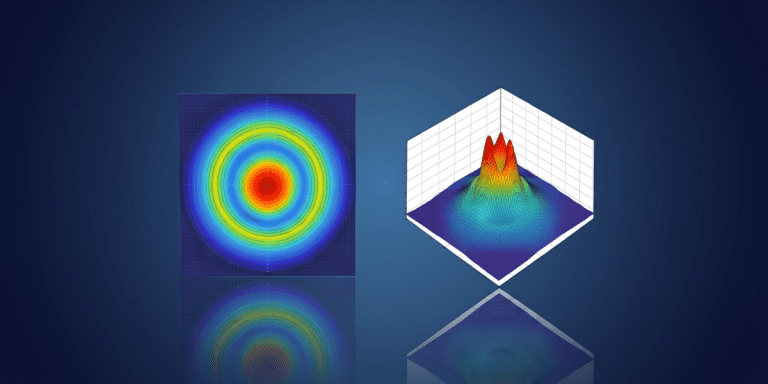
When defense laser systems move from development into integration and verification, beam quality problems become expensive. Hot spots, clipping, poor focus, or alignment errors can slow testing, complicate troubleshooting, and reduce confidence in system performance. Pyrocam IV helps address that challenge with pyroelectric beam profiling across wavelengths from 13-355 nm and 1.06-3000 µm, supporting analysis of laser sources that are difficult to evaluate with conventional camera technologies.
The system combines a 320 x 320 pyroelectric detector array, full-resolution frame rates up to 100 fps, high dynamic range, and compatibility with both CW and pulsed lasers. For defense teams working across multiple platforms, that means one instrument can support beam visualization, alignment, and verification across UV and long-wave IR applications.
How Pyrocam IV Supports Defense Beam Profiling
- Profile UV and long-wave IR laser sources on one platform
- Visualize beam shape, symmetry, clipping, sidelobes, and spatial non-uniformity
- Support alignment, focus verification, and spot-size analysis during development and integration
- Work with CW and pulsed sources using BeamGage Professional software
Why Pyroelectric Beam Profiling Matters in Defense Labs
Many defense laser programs work across wavelengths that are not practical for standard visible or near-IR beam profiling tools alone. That is where a pyroelectric approach becomes useful. Because the sensor responds to absorbed thermal energy rather than relying only on photon-sensitive detector materials, Pyrocam IV can support broadband beam imaging across UV and long-wave IR bands, including applications involving 1 µm-class lasers, CO2 lasers, quantum cascade lasers, and THz sources.
This broader coverage helps engineering teams standardize beam diagnostics across different laser platforms while still capturing the 2D beam data needed for analysis, alignment, and verification. Readers looking for a broader overview of laser beam profilers or other BeamGage camera-based beam profilers can explore those families separately.
Pyrocam IV Capabilities for Beam Analysis and Verification
Pyrocam IV uses a 320 x 320 pyroelectric array to capture two-dimensional beam profiles at full resolution up to 100 fps. Its high dynamic range helps reveal both high-intensity beam cores and lower-intensity wings, supporting evaluation of beam symmetry, clipping, truncation effects, and alignment errors. When used with appropriate attenuation, it can also support characterization of high-power laser sources during lab setup and system verification.
Beam Profiling Challenges in Directed-Energy Weapons (DEWs)
Directed-energy laser systems used for counter-UAS and missile defense depend on controlled beam quality and precise focus to deliver the required irradiance on target. These systems often use kilowatt-class solid-state or fiber lasers in the near-infrared, and even small beam distortions can affect performance.
Pyrocam IV can support DEW development and integration by helping teams:
- Measure near-field and far-field beam profiles
- Verify beam symmetry, focus location, and spot size
- Assess the effects of beam combining, adaptive optics, and relay optics
- Get near real-time feedback during optical alignment and optimization
Because the system supports both CW and pulsed operation, it can fit into multiple stages of the development and verification workflow.
Mid-IR Beam Diagnostics for IRCM / DIRCM Systems
Infrared countermeasure systems often rely on high-power mid-IR laser sources, including QCLs operating in the 3-5 µm atmospheric window. Those wavelengths are outside the practical range of many conventional near-IR beam diagnostics, so direct beam imaging becomes more challenging.
In this context, Pyrocam IV can help teams:
- Verify beam shape and spatial uniformity of jamming sources
- Confirm alignment between multiple emitters or wavelength channels
- Identify hot spots, clipping, or misalignment that could reduce system effectiveness
- Support verification as output powers and multi-wavelength architectures increase
Verifying Alignment in Targeting, Designation, and Range finding
Laser designators and rangefinders commonly use pulsed 1.06 µm or 1.55 µm lasers, while some legacy systems operate at 10.6 µm. Accurate alignment and controlled divergence are important for long-range performance, guidance accuracy, and eye-safety compliance.
Pyrocam IV can support testing and calibration by helping engineers:
- Image beam profiles during setup and validation
- Verify alignment between the laser source, optics, and pointing systems
- Measure beam size and energy distribution for performance checks
- Use one diagnostic platform across multiple defense laser types in the lab
Choosing the Right Beam Profiler for Defense Applications
Not every beam profiling task calls for the same detector technology. If the requirement centers on UV and long-wave IR coverage, Pyrocam IV is the stronger fit. If the application is centered on standard camera-based beam profiling workflows, readers can compare options in the Beam Profiler Finder or review the wider family of laser beam profilers.
FAQ
What makes Pyrocam IV different from standard camera-based beam profilers?
Its pyroelectric detector architecture supports beam profiling in UV and long-wave IR bands that are outside the normal range of many standard camera-based approaches.
Can it be used for both CW and pulsed lasers?
Yes. The product page lists compatibility with CW and pulsed sources, which makes it useful across different lab and verification workflows.
Why does broadband coverage matter in defense environments?
Defense labs often support more than one laser platform. Broader wavelength coverage can reduce the need to switch between different diagnostic tools for different sources.
What kind of analysis does it support?
The system is built for 2D beam visualization and analysis, including beam shape, symmetry, clipping, spatial structure, alignment, and spot-size related evaluation.
Conclusion
Defense laser systems place demanding requirements on beam quality, alignment, and power handling across more than one wavelength band. Pyrocam IV provides a pyroelectric beam profiling solution that supports UV and long-wave IR diagnostics, while also giving engineering teams the 2D analysis needed for development, integration, and verification. For defense labs supporting multiple laser platforms, it can reduce test complexity while increasing confidence in beam performance.
For readers who want to compare profiler options or download supporting software, start with the Beam Profiler Finder and Beam analysis software downloads.