

How to Measure Extremely Low Power Lasers (pW, fW)
If you looked at the Ophir catalog a year or two ago, you could quickly get a sense for the […]
How to Measure Extremely Low Power Lasers (pW, fW) Read Post »
If you looked at the Ophir catalog a year or two ago, you could quickly get a sense for the […]
How to Measure Extremely Low Power Lasers (pW, fW) Read Post »
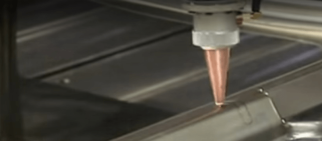
There are so many different aspects of a laser that you can measure. Which leads to the obvious question: “Which
Industrial Lasers – What You Should Measure Read Post »
There’s been some confusion lately about the “laser” setting on an Ophir power meter. Joe will ask: “What if my
How to Measure Different Wavelengths with a Laser Power Meter Read Post »

Finding a laser power meter and sensor to measure power is pretty simple. (Ophir’s meters and PC interfaces are plug-and-play,
Measure a Wider Range of Laser Powers Read Post »
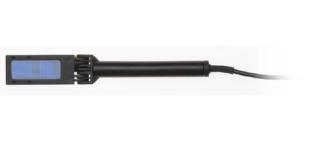
Measuring the power of scanning lasers such as barcode scanners presents a problem. A bar code laser beam scans back and forth at a very high frequency so an ordinary photodiode power meter will not measure the power in the beam but rather the average power impinging on it, i.e. the power times the fraction of time the beam is on the detector. Therefore, when exposed to a scanned beam, the reading will be much lower than the actual power in the beam. For example, if a scanning laser delivers 2mW to a photodiode sensor and the beam is on the sensor only 1% of the time, the instrument will read only 0.02 mW.
How to measure a Barcode scanning laser? [Updated] Read Post »
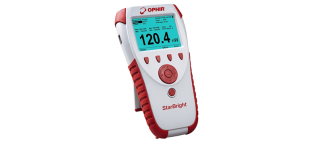
A few months ago, I mentioned a new method for measuring kilowatt lasers without water (or even fan) cooling.
The idea was like this: Even a small 50 W sensor can handle high powers for a short amount of time, like a few seconds. Several of our sensors’ specifications were adjusted to reflect this.
For example, the L40(150)A is meant to measure 40 W continuously, but it can actually measure 4000 W for a second.
“Power from Pulse” – How to Measure High Power Lasers with Small Sensors Read Post »
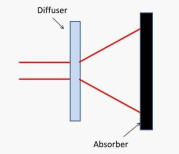
Glad you asked.
Like many answers to many questions, the answer here is “sometimes yes, sometimes no.”
To explain this, we must look at each of the three main types of laser power/energy sensors:
Can You Measure Laser Power with the Sensor on an Angle? Read Post »
Updated March 2016: I made a few changes to this post now that the new low power RM9-PD is available.
There are many different types of lasers.[citation needed]
UV, visible, infrared, Terahertz.
Nanowatts, milliwatts, kilowatts.
Lasers for industry, laser for medicine, lasers for telecommunication.
How to Measure Very Low Power Infrared Lasers[Update] And femtowatt lasers! Read Post »
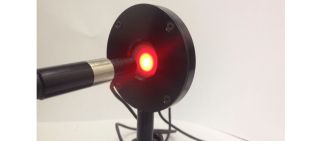
LED’s are used today in many applications with the most prominent being the lighting of our homes, streets and businesses. Despite their clear advantages, measurement techniques of the power, flux and spectrum of LEDs is not very different from that of traditional types of lamps.
White Paper: Measuring LED Power with Thermal Sensors Read Post »
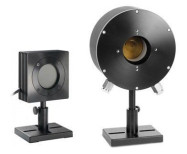
Disclaimer: Don’t do anything stupid.
What I’m about to tell you is a trick that should NOT be used lightly.
However, in many cases Ophir sensors can be used for far higher powers than in the spec, as long as it’s only for a short time exposure.
How To Use a 50 W Sensor to Measure 8 kW Lasers Read Post »
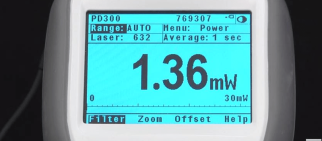
It can be frustrating – trying to measure the power of a laser beam whose power keeps changing. In this video, part of our “Best Practices in Laser Measurement” series, you’ll learn how to get good readings even for unstable beams.
Best Practices in Laser Measurement: How to Measure an Unstable Laser Read Post »
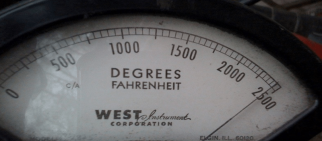
Thermal sensors measure heat.
Lasers heat up these sensors, which is what we want.
But after the laser is turned off, the sensor might still be hot. (Especially true for high powers, long exposure.)
Does this mean the sensor will still show a reading? Should it be zeroed?
Measuring Laser Power with a Thermal Sensor:What Happens When the Sensor Heats Up? Read Post »