How to Profile Extremely Small Lasers: Two Ways
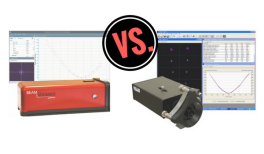
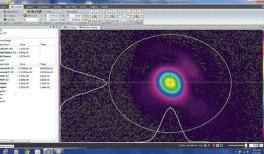
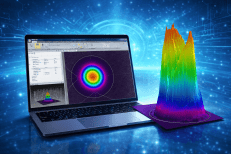
Lasers that are focused very small (< 10 μm) are challenging to profile. This is usually too small to be resolved […]
How to Profile Extremely Small Lasers: Two Ways Read Post »
Lasers that are focused very small (< 10 μm) are challenging to profile. This is usually too small to be resolved […]
How to Profile Extremely Small Lasers: Two Ways Read Post »
There are several considerations when you’re trying to maximize laser power meter accuracy. One that I don’t usually mention is
How to Center Your Laser Beam for More Accurate Power Measurement Read Post »
When laser power gets high enough, interesting stuff happens. One issue that comes up often with laser optics under high
Testing Laser Optics for Thermal Lensing and Focus Shift Read Post »
Pyroelectric sensors are used to measure laser energy. Depending on the sensor, they can measure up to a rate of
Scope Adapter for Measuring Laser Pulse Energy Read Post »
There’s been some confusion lately about the “laser” setting on an Ophir power meter. Joe will ask: “What if my
How to Measure Different Wavelengths with a Laser Power Meter Read Post »
Finding a laser power meter and sensor to measure power is pretty simple. (Ophir’s meters and PC interfaces are plug-and-play,
Measure a Wider Range of Laser Powers Read Post »
For humans, good hygiene is a key to maintaining good health. Same with laser sensors! This video will give you
How to Keep Your Laser Power Meter Sensor Clean Read Post »
Getting the beam size and profile of a UV laser is not trivial. The typical beam profiling solution of a
Beam Profiling and Resizing of UV Lasers Read Post »
The new Ophir StarBright is the most advanced of Ophir’s family of handheld laser meters. This video walks you through
StarBright Laser Power Meter [Video Tutorial] Read Post »
Measuring the power of scanning lasers such as barcode scanners presents a problem. A bar code laser beam scans back and forth at a very high frequency so an ordinary photodiode power meter will not measure the power in the beam but rather the average power impinging on it, i.e. the power times the fraction of time the beam is on the detector. Therefore, when exposed to a scanned beam, the reading will be much lower than the actual power in the beam. For example, if a scanning laser delivers 2mW to a photodiode sensor and the beam is on the sensor only 1% of the time, the instrument will read only 0.02 mW.
How to measure a Barcode scanning laser? [Updated] Read Post »
For maximum accuracy, how much of the sensor’s aperture should the beam ideally fill? This video will give you some
Laser Measurement Best Practices: How much of my sensor’s aperture should I fill? Read Post »
Lasers used in labs must be measured. However, there are usually many constraints, even besides the obvious one (money):
University Research Team Faces Challenges of Measuring Multiple Lasers Read Post »