
语言
安全结账

IS6-D-IR
IS6-D-IR
IS6-D-IR是一个6"积分球(内部5.3"),带有一个用于发散(D)光束的锗探测器。IS6-D-IR配有红外光探测器,校准范围为700至1800nm,最高可测量30W的功率。
- 5.3 in. inner diameter 4-port Integrating sphere for divergent beams
- Germanium photodetector with filter for 700-1800 nm spectral range
- 20 µW to 30 W power measurement range
- Port plugs, covers, adapters and reducers available 查看所有功能

规格
- 产品名称IS6-D-IR
- 型号Divergent Beam
- 球体大小5.3 inch Inner Diameter
- 孔径尺寸Ø26 mm
- 探测器类型Germanium
- 光谱范围700-1800 nm
- 最小功率100 µW
- 最大平均功率30 W
- 最大脉冲能量0.3 mJ
- 最大平均功率密度1 kW/cm²
- 最大光束发散角±60 deg
- 光束发散灵敏度±3%
- CE 符合性Yes
- UKCA 符合性Yes
- 中国 RoHS 符合性Yes
功能
Integrating Spheres for Divergent Light Sources
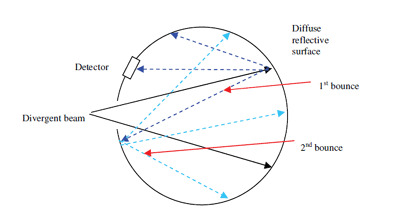
Integrating spheres are used when we have divergent light sources. An integrating sphere has its inner surface coated with a surface that highly reflects (typically 99%) in a scattering, nonspecular way. Thus when a divergent beam hits the walls of the integrating sphere, the light is reflected and scattered many times until the light hitting any place on the walls of the sphere has the same intensity.
A detector placed in the sphere thus gets the same intensity as anywhere else and the power the detector detects is thus proportional to the total incident power independent of the beam divergence. (The detector is so arranged that it only sees scattered light and not the incident beam). An ideal integrating sphere has a surface with reflective properties that are Lambertian. This means that light incident on the surface is scattered uniformly in all directions in the 2pi steradians solid angle above the surface. The surface used by Ophir closely approximates a Lambertian surface.
IS6 Integrating Sphere Overview
For applications that need a large Integrating Sphere, Ophir offers the IS6 series. These are 6” Integrating Spheres, available with and without built-in calibrated sensors, in a range of configurations. Get to know the IS6 family in this video.
Measuring Beams Coming Out of A Fiber
When you need to measure a beam coming out of a fiber, there are some parameters that might have a somewhat different meaning than they do when referring to "regular" beam measurements. Missing some of these points could lead to incorrect measurement, and possible equipment damage. This video clarifies some issues you'll need to keep in mind so you can set up -- and perform -- this measurement correctly.
Calibration Factors - Laser Power/Energy Meter
When a power/energy meter is in "Calibrate" mode, various "Factors" are displayed to the user. This video explains the meaning of each of these factors.
IS6 Integrating Sphere Selection Guide
| 200-1100 nm 300nw-1W |
400-1100 nm 20µW-30W |
700-1800 nm 20µW-30W |
|
|---|---|---|---|
| Collimated beam < ±15° Beam diameter < 25mm |
IS6-C-UV | IS6-C-VIS | IS6-C-IR |
| Collimated beam < ±30° Beam diameter > 25mm |
IS6-C-UV-2.5’’ | ||
| Divergent beam > ±15° Max divergence < ±40° Beam diameter < 25mm |
IS6-D-UV | IS6-D-VIS | IS6-D-IR |
| Divergent beam > ±15° Max divergence < ±56° Beam diameter < 10mm |
|||
| Divergent beam > ±15° Max divergence < ±60° Beam diameter < 5mm |
|||
| Highly divergent beam <±85° Beam diameter < 8mm |
IS6-D-IR-170 |
常见问题
- Integrating spheres are used when you have divergent light sources. How do they work?答案
Integrating Sphere Theory
Integrating spheres are used when we have divergent light sources. As shown in the illustration, an integrating sphere has its inner surface coated with a surface that highly reflects (typically 99%) in a scattering, nonspecular way. Thus when a divergent beam hits the walls of the integrating sphere, the light is reflected and scattered many times until the light hitting any place on the walls of the sphere has the same intensity.A detector placed in the sphere thus gets the same intensity as anywhere else and the power the detector detects is thus proportional to the total incident power independent of the beam divergence. (The detector is so arranged that it only sees scattered light and not the incident beam). An ideal integrating sphere has a surface with reflective properties are Lambertian. This means that light incident on the surface is scattered uniformly in all directions in the 2pi steradians solid angle above the surface. The surface used by Ophir closely approximates a Lambertian surface.
Step 1 – Starting position3A-IS Series
The 3A-IS series has two 50mm integrating spheres in series with a photodiode detector. The two series spheres scramble up the light very well thus giving output very independent of incident beam divergence angle. The two spheres in series also insure that the light hitting the detector is greatly reduced in intensity thus allowing use up to 3 Watts even though photodiodes saturate at about 1mW. There are two models, the 3A-IS with a silicon photodiode for 400 – 1100nm and the 3A-ISIRG with an InGaAs detector for 800 – 1700nm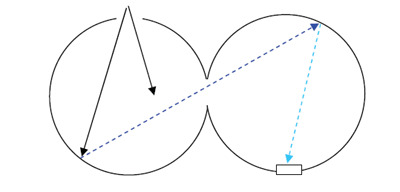
- Do I need to recalibrate my instrument? How often must it be recalibrated?答案
Unless otherwise indicated, Ophir sensors and meters should be recalibrated within 18 months after initial purchase, and then once a year after that.
- There are several models of IS6 integrating sphere detectors. how can I select the right one?答案
There is a simple to use selection guide.
- When using the fiber optic adaptor, how do we handle power loss due to the fiber relative to calibration?答案
All Ophir power meters, including photodiode power meters, have an air gap between the fiber tip and the sensor. Therefore they measure the power emitted by the fiber into the air and do not take into account any reflection losses there are in the fiber. Therefore, if in actual use, the fiber will be coupled with no loss to another element, then the losses should be added to the reading. These losses are usually about 4%. Thus if the reading on the Ophir meter is say 100 mW, then in lossless use, the real power will be 104 mW.
- Are there any special problems with the calibration stability of integrating sphere sensors?答案
The Ophir integrating sphere sensors, models 3A-IS and 3A-IS-IRG have a white diffuse reflecting coating on the inside of the integrating sphere. The sensitivity of the sensor is quite sensitive to the reflectivity of the coating. If the coating absorption goes up 1%, it can cause a 5% change in reading. Therefore, care must be taken not to soil or damage the white coating of the sensors. Also it may be a good idea to send the sensors for recalibration yearly.
- I need to measure the power of a very asymmetrically diverging beam; the Fast axis divergence is ± 80 degrees, while the Slow axis divergence is ± 20 degrees. Will the IS6-D integrating sphere work? It’s specified Maximum Beam Divergence is ± 60 degrees.答案
The IS6-D type integrating spheres (such as IS6-D-VIS, IS6-D-UV, IS6-D-IR) will be good for this as long as you orient the 80 degree divergence in the vertical direction. The IS1.5-VIS-FPD-800 will also work, with the same constraint.
- Among the Integrating Sphere accessories offered, there are “Port Plugs” (white), and “Port Covers” (black). What’s the difference?答案
An unused port should be closed, to prevent unwanted light from entering the sphere. Closing it with a diffuse white port plug, however, adds the surface area of that plug to the (diffuse white) effective area of the sphere that is doing the “integrating”. For a calibrated integrating sphere sensor, this change in the behavior of the sphere changes its calibration, and results in incorrect readings. In such applications, a black “Port Cover” should be used.
- The IS6 integrating spheres have a specified “Sensitivity to beam size” and “Sensitivity to beam divergence”. What is that?答案
In general, as the divergence angle of the beam entering the integrating sphere increases - and as its diameter increases – the assumptions on which we base the sphere’s performance (infinite reflections inside the sphere walls, perfectly uniform distribution of light inside the sphere, etc.) become less correct. We therefore specify the maximum beam divergence (such as ± 60⁰), and we also state the maximum possible change in reading caused by change in beam size. In fact, we also state in the data sheet that the maximum additional uncertainty due to beam size is only ±1% for beam divergence < 30⁰, and ±3% for beam divergence > 30⁰. To give this more meaning: Basically, if you measure the power using a beam that is a few mm in diameter, that has a relatively small divergence angle, and is centered on the sphere’s input port aperture, you can safely ignore this additional uncertainty.
- Can I use my IS6-D Integrating Sphere (which is normally used for measuring Divergent beams) to measure a Collimated beam? I know that normally one would use an IS6-C for Collimated beams, but can I manage with my -D sphere on a 1-time basis?答案
Here is a trick that would make this possible:
The beam should be aimed so that it is incident close to the detector port (but not hitting the baffle) – as shown in this drawing: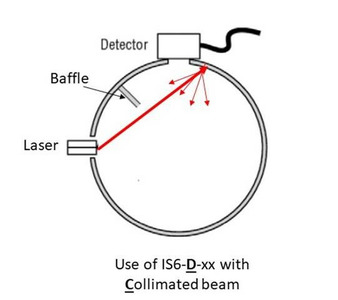
This way the "first bounce" will be directed to the opposite side of the sphere, ensuring that the detector will in fact see only light from the "second bounce" and onward, i.e. light that has been uniformly distributed around the inner sphere surface (normally, light from the "first bounce" of a collimated beam is not yet uniformly distributed and we don’t want the detector to see it – that is the main idea behind the different C and D configurations. This trick gets around that).
配件
Integrating Sphere Accessories
| 对比 | 型号 | 图纸、CAD和参数 | 库存 | 价格 | ||
|---|---|---|---|---|---|---|
 | 7Z08283AIS-2.5" Port plugPort Plug, IS6 Integrating Sphere, Ø63.5 mm, PTFE | 有库存 | ||||
 | 7Z08280AIS-1" Port plugPort Plug, IS6 Integrating Sphere, Ø25.4 mm, PTFE | 有库存 | ||||
 | 7Z08281AIS-2.5" Port coverPort Cover, IS6 Integrating Sphere, Ø63.5 mm, Matte Black Coated | 有库存 | ||||
 | 7Z08282AIS-1" Port coverPort Cover, IS6 Integrating Sphere, Ø25.4 mm, Matte Black Coated | |||||
 | 7Z08305A2.5" to 1" port reducerPort Reducer, 2.5 to 1 inch, IS6 Integrating Sphere, Ø63.5 mm, White Coated | 有库存 | ||||
 | 7Z08306Flange attachmentDovetail Flange Attachment, IS6 Integrating Sphere, for 7Z08305A Port Reducer | |||||
 | 7Z08307Set of aperture masksAperture Set, Ø5, Ø7, Ø10 mm, IS6 Integrating Sphere, for 7Z08305A Port Reducer | 有库存 | ||||
 | 7Z082861" FC fiber adapterFC Fiber Adapter, IS6 Integrating Sphere, Ø25.4 mm, Matte Black Coated | |||||
 | 7Z08350FPD (except FPS-1) to IS6 adapterFPD Sensor Adapter, IS6 Integrating Sphere, North Pole Port, Matte Black Coated | 有库存 | ||||
 | 7Z082891" to SM1 adapterSM1 Thread Adapter, IS6 Integrating Sphere, Ø25.4 mm, Matte Black Coated | |||||
 | 7Z082851" SMA fiber adapterSMA Fiber Adapter, IS6 Integrating Sphere, Ø25.4 mm, Matte Black Coated |
Extended Warranty for Sensor
Customers that purchase the above items also consider the following items. Ophir-Spiricon meters and sensors include a standard manufacturers warranty for one year. Add a one year Extended Warranty to your meter or sensor, which includes one recalibration.
| 对比 | 型号 | 图纸、CAD和参数 | 库存 | 价格 | ||
|---|---|---|---|---|---|---|
 | XWAR-SENSORExtended Warranty for Sensor |
资源
Data Sheets
Integrating Spheres Large Dimensions 5.3” Datasheet(700.9 kB, PDF)
Catalogs
Power Sensors Catalog(11.2 MB, PDF) Laser Power & Energy Measurement and Laser Beam Analysis Catalog(27.5 MB, PDF)
Drawings & CAD
IS6-D Sensor Drawing(264.7 kB, PDF)
Technical Notes
IS6 Sensor User Notes(1 MB, PDF) 5 Situations Where Laser Performance Measurement is Necessary How do I know what range, or scale, to set my power/energy meter to? Measuring Average Power of Pulsed Lasers with Photodiodes(114.5 kB, PDF) Measuring Power of Divergent Beams with Integrating Sphere Sensors
Tutorials
Technical Articles



Have questions? Require assistance?
Click below to contact Ophir Photonics and we'll get back with you shortly.
Contact Ophir Photonics